Sermon: Lent 2 Matthew 15:21-28

Reminiscere Sunday

jesus_2

For an audio recording of this message click the player below:
In the Name of the Father, the Son, and the Holy Spirit, amen!

Remember!  Remember, is the first word we spoke to our Father in heaven in the Introit this morning after receiving His forgiveness.  Remember your mercy, O Lord, and your steadfast love, for they have been from of old.  Today is called Reminiscere Sunday, or “Remember” Sunday.  We want God not to forget us as we struggle and tarry here in all our trials.

Alone-7Have you ever thought you were forgotten?  Have you ever come to God saying, “Remember”, but all you seem to hear is the stony silence of heaven?  I have been there, but even when I know heaven is not silent I as a pastor am called to often travel that lonely road with you as your companion, a brother and spiritual father in Christ.  I don’t know how many times I have prayed for God to make himself known to someone who feels so alone.  For even I, a preacher of the gospel, am tempted to ask of God miracles and proofs greater than His Word and as certain as Christ’s resurrection from the dead.  To be quite frank I often chafe at wrestling and struggling with God at these moments.

            When I was growing up the first Nintendo game system came out.  After a little while I learned how the creators of Super Mario Brothers created secret shortcuts so you could finish the game in 15 minutes or less.  It would take you more than an hour or two if you played straight through.  Other games were like this.  It was almost impossible to survive the game Contra with only three lives, but if you learned the code you could get thirty lives and victory was possible.  I know some of you out there can probably recite the code with me:  up-up-down-down-left-right-left-right-B-A-B-A-start.  Push the correct buttons in the correct sequence and you get the goodies.

I didn’t know then, but these cheats were training my mind to always look for shortcuts and to always expect instant gratification.  Going the long road that took practice, obedience, and perseverance was for clueless chumps.  If you were in the know; there was always a way to easy street.
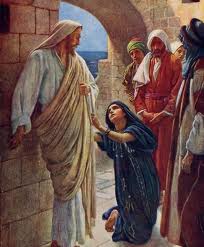
canaanite womanOur gospel lesson this morning shows us that there are no hidden codes or shortcuts in the life of the Christian.  There is a lot of comfort to be drawn from this story of the Canaanite woman, but first let me tell you what it is not.  It is not a formula for how to get what you want out of God.  It is not a story that teaches the moral “Good things come to those who wait.”  Too often people see these great examples of faith in the gospels and conclude then they’ve learned the secret to get God to favor them.  In other words, without admitting it, we think that we can manipulate God.  I heard it once myself when a friend said, “I have waited like the Canaanite woman and the Lord still hasn’t answered.”  The conclusion is either she was doing something wrong or there’s something wrong with God.  Either we’re not pushing the correct buttons in the correct sequence to get the goodies or God has forgotten to hold up His end of the deal.

Jesus gives the Canaanite woman a hard reminder—He tells her that He is not beholden to her person or her will.  He has come for the house of Israel, not the Canaanites.  You are a little puppy Jesus says to her.  He calls her a lap dog, a plaything, not worthy of the children’s bread.

What is shocking is that she says doesn’t deny it.  She says, “Truth, Lord…”  Everything the Lord has said of her was true.  The blessing and mercy of Yahweh had been promised through Jacob who had striven with God and was named Israel.  Israel’s God had chosen to remember His promise to Israel.  He had not made such a promise to any other people and certainly not a Canaanite woman.  “Truth, Lord…” how painful was it for her to say these words?

You probably don’t like how harsh our Lord seems here.  Of course God blesses, of course God has mercy, of course He saves Jew and Gentile alike.  We know this from the Scriptures you say.  How can you say Pastor that it is true that she was an outsider and that God is not beholden to her?  Well, first think on yourselves.  Each and everyone of us.  Think of every reason why God should keep you from His table.  Paul says in our epistle lesson this morning  “For God has not called us for impurity, but in holiness.”  Did you come here pure?  Did you come here holy?  Can any of us here claim we come before the Lord with clean hands, with truthful lips, with faithful hearts?  Haven’t our prayers faltered and our hearts doubted?  Have we not tried to manipulate God and man alike for our benefit?  Can any of us claim we have spent our Christian lives abstaining from sexual immorality, lust, and exercise complete control over our bodies in holiness and honor?  We confess that we deserve nothing, but God’s eternal wrath and condemnation for our sin.  Yet, when we actually see God treating us this way we become indignant and angry—we don’t want to repent.  This text calls us to confess with the Canaanite woman, “Truth Lord…”  we do not deserve the bread on the children’s table.

The amazing thing about the Canaanite woman’s faith is she doesn’t ask for the children’s bread, she asks for the master’s bread.  Humbled, even humiliated, she says, “Truth, Lord, yet even the dogs eat the crumbs that fall from their master’s table.”  She wants not the children’s bread, but the very crumbs that come from the master’s plate.  She will not do with any other bread than His.

Every response Jesus gave to her sounded like a “no”, but in fact He never said “no” outright.   The comfort in this passage comes from the fact that it is so difficult to wrestle with.  God is showing us how His grace can seem concealed when we are tempted and when trials come, but He does this so we will not estimate Him according to our feelings or reason or strength.  Instead He desires us to regard Him according to His Word and promise whether things seem certain or not.  For example when we feel in our conscience that God condemns us and that we truly do not deserve His mercy it can feel as though we’ve gone to hell and are lost forever.  Yet, if you understand the actions of this woman there is great comfort.  Recognizing she could not earn favor she still clings to Jesus as Lord and Master, as the only one who can heal her daughter.  She knows that this man is the true God who remembers all who repent of themselves and call for His mercy.  So also you, can say:  Truth Lord, I am a sinner and not worthy of your grace; but you have promised sinners forgiveness and you came not to call the righteous, but sinners, not the well, but the sick, as St. Paul says, “Christ Jesus came to save sinners of which I am the foremost.”

Can you see the joy in Jesus’ face when the woman responded as she did?  “Great is your faith.” He says.  “Great is your faith” means great is your trust.  Great is your give-able-ness.  A person who trusts knows that no matter what the other person will make good on their promises.  The person who trusts is ready to receive and this woman would receive whatever the Master was willing to give her.  She trusted that even a crumb from His table had power to drive out demons and heal her daughter.  Under Jesus’ harsh words, she heard a hidden yes, and she held on to Him like a bull dog does a bone.  He did remember her.  He indeed remembered His great mercy from of old and showed her that she was truly part of His Israel.

How about us?  In the great struggle and wrestling of faith there is only one thing to do.  We hold on to Jesus even tighter trusting that He will remember His promises.  When you are going through trials and rough times you can say to Him, “Lord you might seem to treat me harshly right now, I may not understand why I struggle this way, and yet I will not let go nor doubt your love for me.  I will rely on you.  You died for me.  You rose from the grave for me.  You have gone ahead of me to prepare a place for me in heaven.  Nothing on earth can separate me from your love, so I will wait.”

And while you wait, He feeds you from His table.  He feeds you with something that is more certain than your thoughts and feelings.  He gives you His Word of promise.  He gives you His bread to eat and His cup to drink; His loving and divine presence in His body and blood given and shed for you to nourish you.  When everywhere else in your life it seems He is against you, you can come here and know He is for you.  Here as He forgives you, assures and comforts you and feeds you, you know that He has not forgotten you or His mercy for you.  In fact, He assures of you that you are known, you are remembered, and you are His.  You have received His name in your Baptism.  His promise is sealed upon you.  Those times of stony silence are His training ground for you to cling all the more to His promises that are more sure than fleeting feelings.  He uses them to drive you back to Him to hear His Word and receive His comfort.  The Canaanite woman walked away grateful for what the Lord did.  We too can look at the difficult times with the same kind of gratefulness knowing that God will remember.

Let us pray:  Lord, have mercy on me! We thank You because we may shout this even when we don’t hear an answer, even when we know we don’t deserve it. We thank You because this is reason enough: We need You. We can’t exist without You. We thank and praise You because Your mercy doesn’t depend on the power of our prayer. We thank You because we don’t need to find the right words, press the right buttons, or try to manipulate Your will. Our knowledge and experience don’t matter. The only thing we need is You. Therefore, we will not stop; instead we will pray over and over to You: Lord, Son of David, have mercy on us.  Amen.[1]

SDG~Rev. Eric M. Estes


[1]Giertz, Bo (2009-01-01). To Live with Christ (p. 205). Concordia Publishing House. Kindle Edition.

Posted in Lent, One Year Lectionary, Sermon | Leave a comment

Sermon: Lent 1 Midweek Matthew 28:16-20

Lenten Midweek Series

Rescued

A Six Week Meditation on the Sacrament of Holy Baptism

Thought for the Day from Bulletin Cover:

            In the first place, you must note in these words (Mt. 28:19, Mk. 16:16) that here stand God’s commandment and institution.  Let us not doubt that Baptism is divine.  It is not made up or invented by people.  For as surely as I can say, “No one has spun the Ten Commandments, the Creed, and the Lord’s Prayer out of his head; they are revealed and given by God Himself.”  So also I can boast that Baptism is no human plaything, but is instituted by God himself.

Large Catechsim, Part IV, paragraph 6

Small Catechism Responsive Reading:

P:  What is Baptism?

C:  Baptism is not just plain water, but it is the water included in God’s command and combined with God’s Word.

P:  Which is this Word of God?

C:  Christ our Lord says in the last Chapter of Matthew:  “Therefore go and make disciples of all nations, baptizing them in the name of the Father, and of the Son, and of the Holy Spirit.” (Mt. 28:19)

Sermon Audio

The evening’s sermon was preached by Chaplain Rev. Graham Glover CPT USARMY.  Chaplain Glover is a member of Lutheran Church of the Redeemer and is presently serving at Fort Benning, GA.

Posted in Lent, One Year Lectionary, Sermon | Leave a comment

Sermon: Lent 1 Matthew 4:1-11

In Nomine Iesu, amen.

It’s that season again!  This is the season where tireless commitment, perseverance and sacrifice are called for.  This is the season that will bring suffering and struggle and even perhaps disappointment and failure when some get off to a good start, but fall short of their goals.  Yet, it’s a season full of hope of what is ahead.

Now, do you think I’m speaking of Lent?  Well of course your pastor has Lent in mind, but at this moment I’m talking about Spring Season.  Spring Training has arrived and the boys of summer are in full swing working hard for the season ahead.  The regular season hasn’t even begun and already fielders are diving to make outs and batters are swinging away increasing their averages.  They risk injury even now, even when it doesn’t “count” before opening day.

I remember Spring Training in little league.  Once I was day dreaming at second base when a line drive came straight at my head.  I was staring off somewhere toward left-center field.  My coach cried out, “Eric!”  Immediately I awoke from my stupor put up my glove and caught the ball inches away from my nose and even turned it for a double play.  My coach pulled me aside to give me a little lesson.  He was a World War II veteran and his lesson could be summed up like this “As you train, so shall you play.”  It was a little play on the military saying, “As you train, so shall you fight!”

Dear brothers and sisters in Christ the Lenten season is here to remind you that you’re not just playing a pastime or something just for sport.  You are in a battle; in fact all of humanity is in the fray.  As you train, so shall you fight!  Our Gospel lesson depicts this contest for us and it shows us everything we need to know about to be equipped.

Firstly, this lesson teaches us to know our enemy.  Secondly, this lesson teaches us to know your victor!

temptation_of_christ

So, to start off, know your enemy.  At this time of year pitching and batting coaches are already studying hours of video finding the weaknesses in pitchers and batters alike.  They’re strategizing at all times.  It is written that Satan the evil one prowls around like roaring lion looking for whom he can devour.  He too has his strategies and he knows our weaknesses.

Epiphany began with the baptism of our Lord where we heard God say, “This is my beloved son in whom I am well pleased.”  Then we heard the voice of the Father again at Transfiguration where He said, “This is my beloved Son, listen to Him!”  This morning we meet another voice; the voice from the depths of treason and hatred for God; “If you are the Son of God…”  The devil’s strategy is always to present a conditionals statement.  “If you are the Son of God…”  So the devil’s trick is always to call the divinity and the authority of God to into doubt.  “Did God really say?” the serpent asked in the garden.  Now he asks God’s beloved Son the very same question.

Sadly this trick has often continued to work on humanity.  One of Satan’s oldest tricks is convince people he doesn’t even exist.  It seems to be working even in the church.  Barna Group recently issued a survey that concluded that 4 out of 10 Christians do not believe Satan is real or a living being.  By the means of modernistic thought that hails science as the only truth or by the cultural relativism that says there is not such thing as good or evil the devil has convinced Christians not to believe the Scriptures that speak of the Evil One as real and powerful.  What a feat the devil has accomplished that the very same people who believe that Jesus is Lord and is Son of God can deny the very one whom Jesus called the “Father of Lies.”

If he doesn’t convince us of this then he does what he does best, he twists the word of God.  It’s always just a little off the truth, “Did God really say…”  He minimizes God’s Word and tries to soften it.  Temptation to sin often comes with it that little voice in the back of our minds that asks “Did God really say?”  It’s the lie implanted into Adam’s heart and inherited by all humanity ever since.  Satan would like you to find your meaning and security outside of the one true God.  Most of the time Satan wants you to trust yourself.  His lie has filled our minds with our “holy” wants, our “holy” needs, and our “holy” desires.  He wants to fill your thoughts either with the comforts of this world or with your worries.  The irony is that he doesn’t care whether what you trust makes you happy or miserable.  He only cares that whatever it is you set your heart on it is not the things of God.

Satan tried to tempt Jesus by having Him provide bread for himself.  Hidden in that lie was calling into question whether God the Father really loved the Son and would provide for Him.  He tried to divert Jesus from the course that the Father planned for Him.  The path that awaited Jesus was a course of suffering and struggle and battle for us all.  If Satan could convince Him that the Father would not give Him daily bread, then maybe he could convince Jesus the Father would not raise Him from the dead.  The devil dares Jesus to test God on this by throwing Himself from the temple to see if God would save Him.  Why not test things now before the going gets really tough?  He then tells Jesus that he can give Him all the glory without the suffering.  All Jesus had to do was find His identity and security in Satan instead.  At all costs Satan wanted Jesus off the path that would lead to the glory of His suffering, death, and resurrection for the salvation of all humanity.

So the enemy uses these tricks on us.  He calls us to doubt God’s provision.  When we’re tempted to sin He asks, “Did God really say…”  When suffering comes he promises us comforts if only we should follow him instead of the Lord.  He promises earthly glory now if only we should trust his ways.

That’s why we must know all the more our victor!  As we hear about these lies and tricks of our enemy we can all think of times we’ve fallen into his snares.  Thank God we have a victor!  Where the first Adam and all others failed, the second Adam, Jesus, has prevailed.  While the Evil One has studied the reels and knows how to monopolize on our weaknesses our victor’s strategy won every inning of this battle.

Jesus’ strategy was simple.  He knew that true identity, meaning, and security could only be found in God His Father.  Jesus did not focus on Himself or on His experience.  He did not say to the Devil, “Didn’t you hear what my Father said back at the Jordan?”  He did not say, “I’m a good Jew and have the right credentials.”  Every attack was replied to the same way, “It is written…”  In every instance Jesus uses the Word of God to thwart the attacks of the Evil One and Satan has no recourse.  The very thing he desires Jesus to doubt is the very weapon that can deflect and destroy him.  And with that Jesus says, “Be gone!”  The devil always has the same strategy throughout the Scriptures, but Jesus stayed the course.  And thank God He did!  For by doing so He went the way of suffering and the cross and bore every sin of humanity that the devil’s lies brought about in the first place.  He paid humanities penalty for believing the lies and God the Father is pleased in His beloved Son for doing so.

“As you train, so shall you fight.”  Brothers and sisters the fight has already begun.  You face temptation daily and the prowling lion would like to devour you.  But, you know your enemy and you know your victor.  Christ has given you a temptation strategy that cannot fail.  Your identity, meaning, and security are found in God alone.  You are baptized into Christ and there you became a new creation.  You are wrapped in Christ and His victory for you at all times.  We are still in the flesh and for this time we will struggle with temptation, sin, and the devil.  Yet the Lord has equipped you as He fights for you.  He has clothed you so you live each day in full-battle-rattle.  You have the weapons of warfare.  You have His Word which instructs you.  You have His absolution that forgives you when you fall.  When the devil accuses you, you can say to the devil, “Go talk to my victor, the one who died and put an end to your lie!”  We even have our victorious Lord’s presence in His body and blood at the altar to forgive, strengthen and renew our faith.  “As you train, so you shall fight.”  Now we can see that these gifts of Word and Sacrament are not optional.  The devil would love to keep us from these things, but the Lord gives them to us that we might share in His victory!  In Jesus’ name.  Amen.

SDG ~ Rev. Eric M. Estes

Posted in Lent, One Year Lectionary, Sermon | Leave a comment

Sermon: Ash Wednesday Psalm 51:1-13

Lenten Midweek Series

Rescued

A Six Week Meditation on the Sacrament of Holy Baptism

 Thought for the Day from Bulletin Cover:

We must think this way about Baptism and make it profitable for ourselves. So when our sins and conscience oppress us, we strengthen ourselves and take comfort and say, “Nevertheless, I am baptized. And if I am baptized, it is promised to me that I shall be saved and have eternal life, both in soul and body.”

Large Catechism, Part IV, paragraph 44

When you wash your face remember your Baptism.

Luther’s Table Talk

In the Name of the Father, the + Son, and the Holy Spirit, amen!

 “You are dust and to dust you shall return.”  This somber rite is a graphic way for you to face your own mortality.  Many in the world would wonder why Christians would subject themselves to such a blunt reminder of their impending demise with a terrifying statement like “You are dust!”

I’ve heard it said more bluntly.  A few years back one of my sons commented on his grandmother’s aging.  In his honest words he innocently said, “Grandma, you’re getting dead!”  This wasn’t long before Ash Wednesday and when she came for the imposition of ashes I was tempted to humorously say, “Grandma, you’re getting dead!”  That is exactly the stark reminder of this day.  We’re all getting dead.  We’re all dust.

“Surely this man must die!”  Those were the words of King David when Nathan came to him and told him about a rich man who stole a lamb from a poor man.  The grave injustice of this man’s sin caused indignation to boil in the king’s bones.  “This man must die!”—but—“You are the man.” said the prophet.  David announced his own death sentence.  Nathan’s story was only a parable.  David had stolen not a lamb, but a wife, Bathsheba.  When she conceived a child he hid his sin by killing her husband Urriah.  David, the great king, was a lying, coveting, stealing, adulterous, murderer.  “Surely this man must die!”

The prophet Nathan had not spoken a single word of condemnation to David.  He told him the parable of the rich and poor man and let David connect the dots.  David condemned himself.  In that moment David learned a truth he later wrote about in our Psalm, “The sacrifices of God are a broken spirit; a broken and contrite heart, O God, you will not despise.”  David was shattered and broken as his life slammed against the rock of God’s Holy Law and Righteousness.  David had transgressed every commandment in less then a week.

“I have sinned against the Lord!” was all he could reply.  His mouth with all its excuses, self-justifications, and deceptions was now shut up and all his tongue could do was confess sin.  That’s what happens to sinners, he shuts them up.  His Law catches us red-handed and even those in deepest denial will one day have to give an account for their deeds.  We should never look at David and think we would never commit such heinous crimes.  We have as much hunger for what does not belong to us as he had.  We are just as tempted to use whatever position we possess for selfish motives.  And yes, our sinful hearts are capable of murder.  We’ve come here on Ash Wednesday to say as David, “I have sinned against the Lord.”

Nathan, still having not spoken a word of God’s condemnation for David’s sin replied simply and clearly, “And the Lord has taken away your sin!”  David expected judgment and death.  God gave him forgiveness and life.  This dark and ugly chapter of David’s life inspired the Psalm we chanted this evening.  It’s rich with reminders of God’s mercy and how he cleanses sinners.

“Have mercy on me, O God,

According to your steadfast love;

According to your abundant mercy;

Blot out my transgressions.”

“Wash me thoroughly of my iniquity,

And cleanse me from my sin!”

“Purge me with hyssop, and I shall be clean;

Wash me, and I shall be as white as snow.”

David knew well that we all need washing and cleansing.  At the temple hyssop branches would be dipped in the blood of the sacrifices and applied to the people as a sign that God had placed their guilt upon the sacrifice.  Hyssop was used to cover the doors with the blood of the paschal lamb at the Passover so that the destroyer would not bring death to Israel’s homes.  Hyssop was used as a cleansing reminder of God’s forgiveness as cleansed lepers would dip it in water and wash their bodies with it.  There were prescribed washings for different occasions and these were given to them as a symbol for God’s forgiveness.

David spoke of all this with one eye looking to Israel’s past where God provided forgiveness at the temple and one eye towards the future when God would send His final sacrifice the Messiah.  These words of David are only possible because God would send David’s Son, the Christ, who blot out our transgressions for all eternity.  Indeed all the other cleansing and washing of Israel was a foretaste of what was to come who would cleanse the world with His blood and wash it with the waters of Baptism.  What David had in only a foreshadow we see in fullness at the washing with water and the Word that our Lord Jesus instituted.

At Baptism God unleashes the sentence that David spoke, “This man must die!”  The sinner surely dies for he is buried in Christ’s death.  This is no mere symbol, but the very sentence that sinless Jesus received for you on the cross is given to you at Baptism.  The death you deserve is given to you in Jesus.

At Baptism God unleashes the absolution that Nathan spoke to David.  As we are buried with Christ we are also raised with Him in His resurrection.  We come to those waters having received the sentence of death and exit them with a new judgment—forgiven.  You enter a sinner and come out a saint.  And this is all God’s doing as David said.  Wash me, cleanse me, purge me, create in me, and renew me.  Only God can save a sinner.

We remember tonight that we’re all getting dead!  Those ashes on your forehead bear that frightful message.  Our meditation doesn’t stop there though.  You might notice that everyone has received their ashes in the shape of Christ’s cross.  Before someone is Baptized the pastor makes the sign of the cross upon the candidate saying, “Receive the sign of the holy cross both upon your forehead and upon your heart to mark you as one redeemed by Christ the crucified.”  Those ashes on your forehead are in fact a reminder of both the death and the life you received in Baptism.  He has promised us in the death-dealing waters of baptism that we possess the life which is Christ’s. His promise will not return to us empty. Death cannot stop the promise of God for Christ is risen from the dead.

ashes forehead cross

In closing meditate this evening on the two quotes from Dr. Luther on the front cover of your bulletin.  When you go home tonight and wash your face, remember your Baptism.  When Satan and your sin and conscience oppresses you with guilt let this by your byword, “Nevertheless, I am baptized.”  For if you are baptized, it is promised to you that you shall be saved and have eternal life, both in soul and body.  In Jesus’ name.  Amen.

SDG – Rev. Eric M. Estes

Posted in Ash Wednesday, Lent, One Year Lectionary, Series A, Series B, Series C, Sermon | Leave a comment

Sermon: Epiphany 4 Matthew 8:23-27

Epiphany 4
Matthew 8:23-27
“With Christ in the Vessel I smile at the Storm”

In the name of the Triune God: the Father, the Son, and the Holy Spirit, amen!

The great Anglican hymn writer and priest John Newton is best known for the beloved hymn Amazing Grace.  The story goes that he wrote the hymn at sea just after God had delivered his vessel from a terrifying deluge.  Captain Newton, commanding a ship full of African slaves as “cargo”, repented of his involvement in the atrocities of slavery and then became a priest.  He became the pastor of William Wilberforce who led the charge to abolish slavery in England.  As a seafaring man John Newton was familiar with storms—real storms—grab your bucket and start bailing kinds of storms.  Another of his popular hymns began this way:

Agamemnon-in-stormBe gone, unbelief,
My Savior is near,
And for my relief
Will surely appear;
By prayer let me wrestle,
And He will perform:
With Christ in the vessel
I smile at the storm.

The disciples weren’t smiling so much in our gospel lesson.  Jesus was the one who decided to cross the sea at night.  Fisherman familiar with the Sea of Galilee would have thought twice about that.  Warm and below sea level it is surrounded by mountainous regions.  The cold air from the mountains would blow down into the warm sea air creating powerful winds and rain.  This would often occur in the evening and night time.  Sailors were also a bit superstitious about the sea.  All ancient cultures saw the sea as the most unmanageable part of the creation and in many ways it is.  Even with modern meteorological instrumentation the seas and the storms that arise still surprise us and catch us off guard.  In the ancient world the sea became a picture of Death itself—swirling and churning with Leviathan and Behemoth—what could a carpenter know about the sea?  Perhaps the fisherman among the disciples thought to overrule Him, but thought better given all the displays of His authority recently.

So, they followed Jesus onto the boat Matthew says.  Matthew is clear, that Jesus puts them on the boat.  It’s His choice and from our informed perspective we know He knew about the coming storm.  That’s something to consider.  Christ could have prevented the storm and averted the danger altogether.  He could have spared the disciples all the anxiety and grief.  Yet, He did not do so.  Again from our informed perspective we know that Jesus loved His disciples.  It’s strange to say it, but He loved them enough that He gave them this experience of salvation.  Think of how different the Gospels would be if Christ had shielded the disciples from every possible threat or failure.  What if Christ had prevented Peter from denying him or Thomas from doubting or James and John from boasting?  The gospels would be very different books.  How prideful and self-righteous would the disciples have become if Jesus sheltered them from failure!

Instead the disciples recorded for us their failures.  This is the first time we see the disciples in action in Matthew’s gospel.  You’d think they would have highlighted one of their successes.  What we get is an ugly scene.  Jesus asks them why they are so afraid, but a better translation of the Greek is that He asks them why they are cowardly.  They’re not just afraid like anyone would be at such a great storm, but they’re cowards at that.  They lacked confidence and trust.  They had no wit about them and no one was leading.  If there was anything they could do to save themselves, whether right or wrong, they would have done it.

Rembrandt_Christ_in_the_Storm_on_the_Lake_of_Galilee

We should be glad they passed this story on though.  The disciples included these stories in their preaching and teaching to show that worthiness is not found in our merits or strength of faith, but in Christ’s amazing grace.  It’s only Christ who saves and the disciples need saving just as much as the leper or the centurion that we heard about last week.  They had seen others as recipients of Christ’s mercy, but because nothing is a better teacher than personal experience Christ saw to it that they should feel His mercies.

Indeed, they felt and saw His mercy in most powerful and awesome way.  There He is sleeping on the stern (or back of the boat for us landlubbers) seemingly unaware and unmoved by the waves that splashed Him tossing their tiny vessel around.  Then when He awakes He is not bothered one bit by the scene He meets.  The disciples cry to Him, “Lord, save us!”  What’s astonishing is the simplicity of what Jesus says to the storm.  There’s no incantation, no wand, or waving of the hands.  He’s not like Gandalf facing a Balrog slamming down his magic staff yelling, “You shall not pass!”  There’s no epic Hollywood standoff going on here.  Jesus just rebukes the storm like you would speak to a disobedient child.  In Mark’s gospel He says a single word in the Greek, “Be still!”  And at the moment of His rebuke Matthew says “there was a great calm.”  What Matthew’s getting at that it wasn’t a subtle change as the wind and waves calmed down.  In that moment there was great calm and they were sitting on the sea like nothing had ever happened.

Now, there’s something theological Matthew is getting at too.  All ancient cultures believed the sea to be impossible to manage or control and rightfully so.  Though the disciples had seen Jesus cleanse a leper, heal a servant from afar, and restore Peter’s mother-in-law to health they still doubted the extent of Jesus’ power.  No man can control the seas.  Only God can do that, but Jesus did it.  By doing this Jesus is saying, “I am not one who is calling on power, I am power.  Anyone who has any power on earth is getting it on loan from me.”  This is the creator controlling the creation.  It was because of things like this that St. John would later write about Jesus saying, “All things were made through Him, and without Him was not anything made that was made.”  Still at this point the disciples wondered at who He was for they knew only God could order the sea to calm like a master orders his dog to sit.

There’s something even deeper going on here though.  Interestingly Matthew and Mark both use the same kind of language in the account of Jonah from the Greek translation of the Old Testament.  There are some important parallels between these stories.  Both have storms, both have men scared to death, both Jonah and Jesus were sleeping, and both calm the storm, but for very different reasons.  Jonah was thrown into the storm to appease God’s wrath because of his sin.  We don’t see Jesus doing that or do we?

12-sketch-of-christ-on-the-cross-eugc3a8ne-delacroixLater in Matthew 12 Jesus refers to Jonah as a proof that He would rise from the dead after three days.  What He was saying was the He was the greater Jonah.  On the cross Jesus would be thrown into the greatest storm mankind will ever hear of, but it was a spiritual storm.  Jonah was thrown into the storm for his own sins; Jesus faced the storm of God’s judgment for all sin because none of us could survive it.  His death and resurrection verify that He is trustworthy and He is loving.  He won’t fail you.  Your Baptism into His death and resurrection is His personal promise to you.  You’re safe in His death.  You’re safe in His resurrection.

keep-calm-jesus-is-risen-1It’s important to note that the same cowardly disciples would become the same men who would face persecution, torture, beheading, and crucifixion for the sake of the news that Jesus is both God and man, both Lord and Savior.  There many failures taught them that because Christ is in the vessel they could smile at the storm.  We too can have our cowardly moments.  When it feels like the boat is about to capsize.  When the doctor says, “I’m sorry there’s no more I can do.”  When the winds blow the economy one way or another and we wonder how we’re going to manage.  It’s moments like these we can flounder.  That’s not to mention if God calls us to face violence and persecution for the sake of the gospel and there’s always the hour of death where even the most stalwart can begin to despair.  That’s why I’m glad we have these accounts, aren’t you?  The disciples are usually men of “little faith” in the gospels, so it leaves a lot of room for “little faith” ones in the boat.  Even cowards and little faiths get saved.  This account shows us that it’s not the strength of faith that matters, but instead the power of the Savior that faith trusts.

These stories keep us in our place and keep us from ever becoming too prideful.  We are weak.  Yet they also call us to a finer more confident faith.  A faith that trusts the Lord’s salvation and is courageous enough to call on Christ in all times of trouble.  No matter what storms may come we have the assurance that nothing that tries to overtake us can ultimately end us for Christ has saved us and will raise us in the great calm of the New Heavens and New Earth.  Knowing and trusting Christ this story can lead us to pray where we began with John Newton’s words:

Be gone, unbelief,
My Savior is near,
And for my relief
Will surely appear;
By prayer let me wrestle,
And He will perform:
With Christ in the vessel
I smile at the storm.

In Jesus’ name, amen!

Posted in Epiphany, One Year Lectionary, Sermon | Leave a comment

Sermon: Epiphany 3 Matthew 8:1-13

Epiphany 3
Matthew 8:1-13
“I want to!”

In the name of the Father, the ╬ Son, and the Holy Spirit, amen!

Once sitting around the dinner table Martin Luther said to his company, “Oh, if I only could pray the way this dog watches the meat!  All his thoughts are concentrated on the piece of meat.  Otherwise he has not thought, wish, or hope.”[1]  One could conclude from this that Luther was teaching some kind of prosperity gospel.  Only pray hard enough and keep your eye on your wish or hope and God may be more likely to give it to you.  This is not Luther’s teaching.  What is prayer’s object and goal?  It is communion with God and the object of prayer is always God just as Christ taught us to pray, “Our Father, who art in heaven etc.”  Just as the dog sitting below the dinner table won’t take his eyes of the delicious morsel on his master’s fork, so Luther wished he could pray and maintain focus on God whom he prayed to with the same unwavering attention.

We heard about two examples of this kind of dogged faith in our Gospel lesson.  The healing of the leper and the centurion’s servant come right on the heels of the Sermon on the Mount.  Much of what Jesus claimed in word, now He does in deed.  The Sermon on the Mount opens with the beatitudes where He promises that the poor in spirit, the mourning, and meek are blessed.  So, for His first miraculous healing He heals a leper in a very surprising, controversial, and comforting way.

Jesus preached blessing to the poor and ostracized in his sermon and now he is approached by one of the poorest and most ostracized characters of the ancient world, a leper.  Lepers were isolated from the community of Israel.  This man who approached Jesus directly would have to warn anyone to stay away from them.  It was quite shocking he’d be so bold to approach the Lord.  He was isolated from his family, his work, and his house of worship.  There were perhaps misunderstandings about how skin diseases could be contracted, but Israel’s greater concern was his and all lepers’ ceremonial uncleanness.  His white and flaking flesh was a constant testament to the reality of our brokenness and the sinfulness of the world.  That’s not to say he had sinned to deserve this plight, but rather he found himself in a place of constant uncleanness.  He had reached a point of no return; no washing or cleansing was possible.

So as Christ came down from the mountainside the crowds followed him and in this crowd the first person to interact with him is this unclean leper.  “Lord, if you will, you can make me clean.”  These words are a confession of faith; the faith that the preaching of Jesus had created in the man there on the mountain.  His confession and prayer is a beautiful example of the dog-like faith Luther spoke of.  First, he called Him Lord.  The leper recognized that Jesus spoke with His own authority unlike other rabbis.  By calling Him Lord the leper was confessing his subjection to Jesus.  Then he says, if you will.  This treats Jesus with respect.  He recognizes that Jesus does not have to do anything against His will.  Then the leper says, you can make me clean.  This statement recognizes Jesus’ competence and ability.  The leper believed that Jesus did not just give a good sermon, but could accomplish the very blessing He promised.

This true faith is a fine combination of respect (if you want to) and confidence (you can make me clean).  Though this might be like the dogged faith that won’t take its eyes off the prize it honestly recognizes that it cannot know if the Lord in every case intends to heal.  Not every leper in Jesus’ day was cleansed.  We still have over 200,000 cases of leprosy around the world each year.  No matter how many illnesses we may beat all people eventually die whether they have faith or not.  Christians who desire healing often think of Paul’s thorn in the flesh which was never removed.  After much prayer Paul recognized that this weakness was given to him so that he would not become prideful.  Instead he learned to rely on God’s grace for God’s power is made perfect in weakness.  He knew this was true for God’s power was perfect even in the weakness of the Cross of Christ.

So we cannot presume to order God around.  This leper does not, the centurion later on does not try to boss Jesus around in his display of great faith.  Rather, faith is marked by confidence.  There is no, “you might be able to do this…” in the leper’s thoughts.  As we look more at the leper’s petition we see that it’s less of a request and more of an affirmation of who Jesus is.  “Lord,” a religious word in Jesus’ day, “if you want, you can make me clean.”  Indeed, he never asks, “Will you make me clean?”  He just states the facts.  You can make me clean!  His words are not just about his desire to be healed; they are in fact about the One who has power to heal.  Faith is not some general belief in God like so many people have.  It is a particular trust in God’s Son and a certain hope that He is able to help us with our deepest problems.

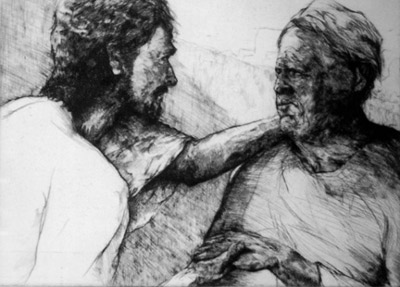
What follows is the most comforting and yet controversial part of the lesson.  The man is close enough to touch and Jesus grasps the man and while doing so says, “I want to, be clean.”  Jesus made himself ceremonially unclean in that instance.  No rabbi or prophet would ever do that.  We saw Elisha would not even go out to Naaman in our Old Testament lesson.  Moses healed his sister Miriam when she became leprous, but never touched her.  The affliction of the leper cannot taint Jesus though.  Instead the clean One grasps the unclean and the leper is cleansed.

This is the easiest miracle to understand.  The gospel is in that touch.  This leper likely hadn’t had human contact of this kind in years if not decades.   Now in this touch from Jesus we have God’s identifying love.  It is the good news that God through His Son Jesus touches all of us; He even enters physically into our lives, and makes us His own.  On the cross He received the uncleanness of the entire world.  By His cross and resurrection every infirmity will be healed at the resurrection on the Last Day.  Until then He constantly gives us this identifying love of God.  He does so time and again in the forgiveness of our sins and the healing we first received in our Baptism to this day.

Having this hope the Church should also pause here and consider what Jesus has done for this leper.  It should be no surprise that leper colonies became early Christian mission fields.  Jesus in word and deed proved Himself to be Christ the Lord and Savior.  So we at Redeemer should consider this for the ministry our Lord has given us.  A believable ministry of the Word and the Sacraments that we have here every Sunday will be accompanied by a compassionate ministry of deed in love and service of our neighbor.  It would benefit us to consider how we together can show compassion to our neighbors around us.  Especially we must consider the ostracized and the unwanted like this leper.  Those are conversations we need to have.

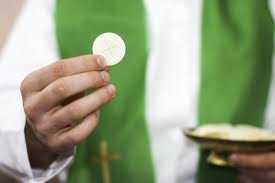
In closing let’s return to our Lord’s words that are so comforting as we receive His love and seek to love our neighbors.  Words without deeds are unimpressive, but deeds without words can be confusing.  Jesus gave the leper both.  He gives Him the words the leper most needed to hear and us too.  As He healed the man, Jesus said, “I want to…”  It’s Jesus’ will to do these things.  He does not in anyway feel forced or compelled against His will to save us.  So, these simple words reveal something very profound about your Lord, not only has He saved you, but it was His absolute desire to do so.  As we share the gospel it’s always important to emphasize this point.  It’s not like God treats us like a master throwing his obstinate pup some scrap from the table.  No, God not only invites us to sit at table and dine with Him, but these words of Christ reveal something of God’s inner life.  He invites you to table to feed you and heal you; and as He does so He says, “I want to…”.  In Jesus’ name, Amen.

wafer


[1] Luther’s Works, American Edition, 54:38, 18 May 1532 no. 274

Posted in Epiphany, One Year Lectionary, Sermon | Leave a comment

Sermon: Epiphany 2 John 2:1-11

IN NOMINE JESU

Dear brothers and sisters in Christ Jesus, all of us, I am fairly certain, have heard of or witnessed firsthand, miracles. Doubtful any of us have seen someone rise from the dead, or as in the case of our Gospel text this morning, turn water into wine. But I’d venture to say we are all familiar with miraculous stories of diseases mysteriously healing or people walking away from accidents that should have left them dead or in a comma. For those of you who work in the medical field, I’m sure your experiences with miracles are far greater than most. If you Google the word, miracle, thousands of stories and examples will populate your feed. In many respects miracles seem to be everywhere – occurring every day, in every corner of the earth – from simple to profound moments that oftentimes leave us speechless. As infrequent and uncommon as we think they are, miracles really are all around us.

It was a little less than a month ago that the Church celebrated one of its greatest miracles – the birth of our Savior. That a young woman would consent to the archangel Gabriel to bear the promised Messiah; that her betrothed would remain ever loyal to this maiden and name the child as the angel commanded him; that this couple would flee their hometown of Bethlehem to Egypt in order to escape the evil hand of Herod; and that this same couple would marvel and gladly receive the words spoken of their newborn child by the devout Simeon; are but a few of the instances that surround this miracle. It was and remains the beginning of many miracles associated with the one we call Jesus.

And so it is on this Second Sunday after Epiphany, a season where we celebrate the miracle that is the Incarnate Christ, that we hear again about our Lord’s first sign – His first publicly recorded miracle – the changing of water into wine at the wedding feast in Cana. Attending a wedding with His disciples and Mother in Galilee, our Lord is told by Mary that the wedding host had run out of wine. Following the guidance of the Blessed Mother, the servants listened to Jesus’ instructions and filled six stone jars with water. After taking these jars to their master and drawing from them, the water became wine and the wedding feast continued with great jubilance and joy. And so it was here, at this feast and in this miracle, that our Lord’s glory was revealed – a glory St. John describes no less than 17 times in his Gospel text.

You know, I really like our Gospel this morning. It’s not simply because the text includes a reference to that most noble gem, that great saint and exemplar of the faith – the Blessed Virgin Mary. Nor is it because I enjoy a good wine (although six stone jars might be a little past my limit!). And it’s not because I so eagerly like to point out to my Christian friends, especially my teetotaler chaplain peers, who think the consumption of alcohol is sinful, that the first miracle of our Savior was changing water into wine! Rather, I enjoy this reading for the same reason I think so many of us do – we simply like encountering our Lord doing miracles. Referencing passages that testify to the miraculous nature of Jesus is something we oftentimes do in an effort to prove who Jesus is. Engaging those around us in conversations about our faith, pointing out examples like that which St. John records is a means for us to illustrate to others that Jesus is who He would later proclaim to be – namely, the Son of God – the promised Messiah of YHWH.

This enjoyment – this desire of ours to “prove” our faith – is something I find Christians doing on an increasingly frequent basis. On one hand it makes perfect sense. We live in a world with growing numbers of competing faiths and philosophies. The one holy catholic and apostolic church’s claim to absolute truth is no more. Christianity may have more adherents than any other faith, but those that deny the Triune God and reject faith in the Christ are to be found by the millions in every corner of the earth, including those in our own neighborhoods and communities. Many of us may wish nostalgically for a time when the Christian faith was the mainstay in society. Whether or not this ever was the case I’m highly skeptical, but I know such a reality will never occur until our Lord returns for His Second Advent.

Moreover, we seek to “prove” our faith because we see people, including those in our families and closest to us, doubting the teachings of our Lord and His Church. On this reality I could lament for hours on end. You know as well as I that our world is filled with sin, that there are those – including we who sit in these pews – who daily and frequently turn from our Lord’s commands and commit sinful acts we all know to be unrighteous and ungodly. Which makes us think if only we can prove to others (and ourselves!) that Jesus truly is Lord of our lives and that we ought to do everything which He proclaims…well, then maybe we won’t be so inclined to sin and perhaps the world in which we live will turn from its sinful ways.

But here’s the problem with such thinking – we don’t need to “prove” anything. Proving that Jesus is the Christ is not our task. Our call as Christians is not to construct some grand plan that convinces the world that Jesus is who St. John and the other disciples proclaimed. Granted, the Church is commended by our Lord to go, teach, and baptize. She is called to be a witness to the miracles of the One who changed water into wine and later would do the miracle of miracles by becoming sin for us, defeating the power of Satan by His rising from the dead. But the Church need not consume herself with the business of apologetics. Ours is not to prove, as Christ has already done so. Ours is not to convince, as the Holy Spirit moves the hearts of individuals when and how He pleases. Our confession should never be one we find confidence in simply because our explanation of God is better than others. To do so would belittle our faith and make it one merely of reason and philosophy. In other words, our ability to win a debate with an unbeliever or doubter does not make our faith valid.

Which is why in this season of Epiphany – in this season of miracles – we rejoice and find confidence in our faith solely because of who God is, what He has done, and what He continues to do. Our call this day is simply to confess that which has been revealed to us. This call is not something we find on our own. It is not something we seek out. We cannot grasp it by our reason or through philosophical argumentation. In no uncertain terms, it is not something we need to prove. It is a gift – a miracle – given to us by God through His means, His Holy Word, His Holy Sacraments. Our call to faith is never a past tense proof. It is a here and now reality.

My dear friends, miracles truly are all around us. They are evident in our everyday lives. They are found in this congregation and among its members. They were present at our Lord’s Nativity. We encounter them at the wedding feast in Cana. And we witness that miracle of miracles when Jesus rose triumphantly from the grave. Today they are evident in the waters of Holy Baptism as Rebecca’s name was written into the Book of Life. They will be given to each of you when you come on bended knee to receive into your mouth the very Body and Blood of our Lord. So rejoice and be glad. Rejoice and be glad in this gospel text and our mutual faith. Rejoice and be glad, never worrying about proving your faith, but simply letting Christ be Christ. In the name of the Father and of the X Son and of the Holy Spirit.  Amen.

SOLI DEO GLORIA


Rev. Graham B. Glover

Posted in Epiphany, One Year Lectionary, Sermon | Leave a comment

Sermon: Epiphany 1 Matthew 3:13-17

In the name of God the Father, the Son, and the Holy Spirit.  Amen.

I spoke to a man who began a career in a nursing home many years ago now.  His training was more rigorous than one would expect.  He shared with me his second day on the job.  He said in order to more deeply identify with the residents of the home he got to spend three days as a resident.  He did this willingly as all the other employees did.  He said many people would quit on day one.  I wondered why.  It sounded simple until he explained more.

He spent all three days in a wheel chair.  He was not allowed to use his arms to spin the wheels only his feet.  Since he was still strong unlike the true residents he had to wear socks that would slip and slide on the tile making it more difficult to move.  They put glasses on him covered with a thin layer of Vaseline to make it harder to see.  The staff bathed him, assisted him in the bathroom, helped him dress, helped him in and out of bed, they even fed him.  He told me by the end of the experience he felt a little violated, a little embarrassed, and extremely humbled.  He also said he would do it all over again if he was asked to.  He came to identify himself with people three times his age in a way he never expected.  As he served them he knew and they knew he was just like them.

As we’ve celebrated the last couple of Sundays in Christmas we saw that Word made Flesh came among us in a hidden way; as a baby, as a boy in the temple, as a carpenter in Nazareth.  He is God in the flesh, but he looked just like one of us.  In fact he is one of us.  We may at first want to chafe against the thought that he is like us because he is also God and Lord.  For the moment though don’t steal from yourself the comfort that Jesus who serves us is just like us according to his human nature.  His human nature is just like ours of course without the taint of sin.  He understands the tension between our strength and frailty, our capabilities and neediness, our joy and our sorrow.  He understands us from personal experience as God in the flesh.  Think about it and be amazed.  Almighty God came to identify himself with you just as you are.

That’s what confused John the Baptist in our gospel lesson this morning.  Jesus was going to receive John’s baptism—a baptism of repentance for the forgiveness of sins.  Though they were both men John knew the difference between himself and Jesus.  Sinless Jesus did not need to repent, be baptized, and forgiven.  John did.  He needed Jesus to baptize him, so he thought.

Jesus insisted that he be baptized though.  Why?  He says it himself.  So he could fulfill all righteousness.  This is confusing.  Jesus is the God-man, he doesn’t need righteousness, He is righteousness incarnate.  But here’s the thing.  He didn’t say he came to fulfill his righteousness, but all righteousness.  He is the Lord, God in the flesh, and he comes to be baptized.  The sinless one came to the waters of John’s baptism to begin the work for which the Father had sent him, to have the cross laid on him so that he could fulfill all righteousness.  The Sinless One is baptized as a sinner.  The one who needs no repentance receives the baptism of repentance.

How does that word “repentance” make you feel?  How do you react when you’re told to repent?  Do you immediately say, “Okay” and fall to your knees?  Most of us, even Christians, first ask, “What do I need to repent for? What did I do?”  We’re tempted to flash a Christian identification card and say “I get plenty of repentance at church.” Or deflect the attention to others and say “I may not be perfect, but I’m not as bad as those other people.”

Thank God that he soon stops our excuses and brings us to repentance.  Luther wrote in his 95 Thesis, that when Christ says “Repent” he means for the whole life of the Christian to be one of repentance.  This is what John was teaching at the Jordan too.  He called all to repent and to be in constant repentance as they received the forgiveness of their sins.  As the Christ came into the world so we needed to repent and recognize God’s righteousness and that we have no righteousness of our own.

Jesus had neither kind of sin— not the original sin of Adam nor any sin of his own.  He had nothing to repent for and yet he willingly accepts a sinner’s baptism.  I mentioned earlier the powerful example of a man who willingly suffered the humiliation of a nursing home so that he could identify himself with every patient he served.  Jesus did something much more powerful.  He willingly and intentionally received a sinner’s baptism so he could stand in solidarity with all sinners.  This is Jesus identifying himself with you.

John is right that a sinner needs to be baptized by Jesus.  The lesser ought to be baptized by the greater, but here we see again the upside down nature of God’s Kingdom.  You might want to think of Jesus’ baptism as your baptism done backwards.  In our baptism into Christ we receive the forgiveness, life, and salvation that he won for us on the cross.  As we’re washed by the water and the Word we receive Christ’s righteousness and our sin is washed away.  Jesus’ baptism is exactly the opposite of yours.  He identifies himself with you as a sinner.  He was inaugurating what he would do for you on the cross.  On the cross he would be covered not with water, but with your sin and die the death you deserve.  He becomes the sinner so that you might become the saint in His gift of baptism.

In the Name of the Father, the Son, and the Holy Spirit.  Amen.

Posted in Epiphany, One Year Lectionary, Sermon | Leave a comment

Sermon: Epiphany Isaiah 60:1-6, Matthew 2:1-12

Grace, mercy, and peace to you in name of God the Father and our Lord and Savior Jesus Christ.  Amen.

Perhaps the Christmas glow has warn off a bit for some of us.  The gifts have all been unwrapped.  The work schedule is back to normal and soon the kids will be back to school.  The decorations are put away or at least you’re trying to figure out how to find time to do so.

In the Church year Christmas is only 12 days and then it makes way for Epiphany, but that doesn’t mean the glow of Christmas does not still shine.  When someone gives you a Christmas gift you unwrap it, you say thank you, and then you put it to use; if clothes or jewelry you wear them; if a toys you play with them; if food you eat it.

The relationship of Epiphany to Christmas is like this.  Christmas is when you unwrap the gift.  Epiphany is when you get to take it out of the box so to speak and see what it does and enjoy it.  God’s Christmas gift is a gift like no other.  In this gift God gives you himself.  With the Christmas child you can know the heart and mind of God.  You learn of his good will toward you, his mercy, and unflinching determination to making us his people forever!

As we give our thanks to God for this gift and this day of Epiphany we start to see the beginnings of how this gift works, what it’s all about, and how we can enjoy it.

“Arise, Shine!” God says to you, “Your light has come and the glory of the Lord has risen upon you.”  By the light of a star the Wise Men were led to the Light of the World, the Christ child, to walk no longer in the darkness of the earth, or thick darkness that covered the people.  They abandoned the darkness of their gods, their house gods, their cultural gods, their gods of science and stars which by grace the true God would use to bring them to hear His Word in Jerusalem before they’d go to see the Word Incarnate in the arms of his mother.  Now by the light of the very same Word you walk in the light as the Magi did!  Arise, shine!  Your light has come and the glory of Yahweh has shone upon you.

That was Epiphany then, but are we to be bystanders watching as these men bow down to worship their salvation who was by that time many months old or perhaps over a year?  Indeed, how sad it would be if that’s all Epiphany meant for us.  If it only served to have a few words of Isaiah’s prophecy fulfilled, that is men coming from the east, bearing gifts of incense and gold, though that is awesome it also would be a pity for that means the gift has nothing for us now.

Epiphany holds much comfort and joy for us now.  This morning we identified ourselves with Herod, which seems a difficult thing to do, but we confess of our little Herod like rebellions against God every time we confess our sins.  This evening we identify with the Magi.  They seem mysterious, but they too in many ways are Everyman.

They were spiritually lost outsiders whom God chose to guide to His Son.  Ironically the Father did this by using their false trust of the stars.  Guided by the star God brings them to Herod’s palace to hear the Scriptures and then go to Bethlehem and see Christ whose birth the angels sing.

The moment the Magi met the child they were immediately unemployed.  They’d been searching the skies all their lives looking for truth.  They’d become rich doing so as they looked for purpose, meaning, wonder, and salvation from the sky.  Now, the true God had led them to a little town and shown them that all that they thought they could find in the stars is contained here in this little child.  He is the purpose of their lives, to become heralds to Jerusalem and back in the East that God had sent a Savior king.  Their idols were smashed the moment they knelt before their king and savior.

Like the Magi we search for purpose, meaning, and wonder.  We can try to find it by stirring up religious feelings on Christmas and Easter.  We can try to find it by giving ourselves to our work and burning the midnight oil at the altar of success.  We can try filling our lives with healthy relationships, healthy families, and healthy friendships.  We can try to control our lives by deciding what might give us meaning apart from the Christ child.  The only problem is we know from experience eventually all those things we use to replace Him fall short.  They’re like chasing after stars.  Feelings wear off, work soon turns into monotony, healthy relationships can always be healthier, friends and family die.

Epiphany shows us that the God has prepared everything you need for purpose, meaning and wonder wrapped up in a little child.  You’re no longer blown about by the wind of your emotions.  You don’t doubt your value before God because you had a bad day or because of your sins.  You look to Christ who showed you His love, God’s love, by lying down His life for you; taking your sins with Him.  You don’t have to be a victim of the workaday doldrums, because as Christ said, “Whenever you have served the least of these my brother you have also served me.”  Your work has purpose and meaning not because of the paycheck at the end of the week or the accolades of your coworkers.  It has meaning because God has given it to you to glorify Him, to love your neighbor, and to grow in trust in His forgiveness and love because work is not without it’s own sins and challenges.

Epiphany also keeps you from making an idol of your relationships.  You have the greatest relationship you could ever ask for in your King and Lord Jesus.  When relationships are strained and trouble arises you have the peace and assurance that in Christ you are always reconciled to God.  When Christian family and friends and are lost to death you can look to Christ and remember His resurrection from the dead.

This just touches the surface of all the meaning wrapped up in Epiphany for us.  Following the way to King Jesus doesn’t take us out of the world, but into the world to shine as beacons of His light who all point to the King of crib and cross.  Epiphany points us again and again to our Savior enthroned in the arms of a mother.  Enthroned with thorns for a crown, a spear for a scepter, a cross for a seat and now He is enthroned at the right hand of God the Father almighty. Likewise, now and always like the Magi He has the throne of our hearts.  Even now He dwells in you by faith and as you received His true body and blood this morning at this altar.  In Jesus’ name.  Amen.

Posted in Epiphany, One Year Lectionary, Sermon | Leave a comment

Sermon: Christmas 2 Matthew 2:13-23

In the name of the Father, Son, and Holy Spirit.  Amen.

Merry Christmas!  Our text for reflection this morning is our gospel lesson Matthew chapter two.  With all the beauty and merry making of Christmas the church decided centuries ago to dive headlong into the sharper edges of the Christmas story.  Of course that was easy for our ancestors to decide because that’s exactly how the true story of Christmas goes.  The Evil One, God’s foe, wanted to thwart the Almighty’s plans.  So, he tried to remove Jesus from the picture immediately.

Herod was a willing instrument for the Devil.  He was a suspicious and ruthless dictator.  He’d killed his own sons to protect his throne.  He even had a wife executed later in his life.  What are a few two year olds in a tiny town south of Jerusalem to him?  It was said that it was safer to be one of Herod’s dogs than one of his sons.  His paranoia and his hunger for power enslaved him.

Now, God’s Son had arrived, the one born to be true king of the Jews.  Herod heard the Word of God along with the Magi.  He was invited by the Word of Christ to come to Bethlehem and see Christ whose birth the angels sing.  Herod could go and bow at the manger like the shepherds and outsiders from the East.  He could have the true peace of God, but he would not.

We like to think of Herod as the Gospel villain.  We see the depth of his sin and treachery and think it outside the realm of possibility for most men; but Herod is Everyman.  Herod teaches that the response of raw human nature to the kingship of Jesus is rebellion.  If Jesus is Lord, then we are not.  Our first sin was an attempt to become like God and we’ve been trying ever since.  So, when God shows up our counterfeit Lordship of our lives is exposed for what it is, a delusion.  Herod was delusional.  All sinners are one way another.  We try to play God.  Though Herod is an extreme case, he is not an isolated one.  Herod is what every man is deep down inside.  Every sinful act you commit is the little Herod in your heart tempting you anew to doubt, hate, and resist the real king to unseat Him for the throne of your heart.  As Martin Luther warned in the Large Catechism, “For our flesh in itself is corrupt, and inclined, to evil, even after we accept and believe God’s Word.”

So notice how we prayed against this little Herod today in the Collect.  “Almighty God, you have poured into our hearts the true Light of Your Incarnate Word.  Grant that this light may shine forth in our lives…”  Faith desires Jesus to be on the throne of its heart and prays for His light always.

God can deal with the likes of Herod.  God thwarted the Devil by protecting His Son by giving Him Joseph who fled with the baby and His mother to Egypt.  Herod in all his authority and might couldn’t overcome one little baby.  He comes out the fool and dies.  So, goes the rest of the gospel.  A poor carpenter turned rabbi will preach and teach in a small part of the world.  The powers therein will try to kill Him and they will think they have succeeded when He’s crucified.  Yet, then comes the third day when it’s proven that God’s power is glorified in weakness, even the weakness of a cross, and what the Christ accomplishes yields fruit to eternal life.  The Kingdom of God starts as the smallest of seeds and then spreads (and is still spreading) to the four corners of the world.

The Herods of the world will all die one way or another, even us.  God deals with them in two ways.  For the unrepentant like the first Herod God will thwart their plans and accomplish His purposes in spite of them.  The other way is even better.   He still kills them, but raises them again with Jesus.  That’s exactly what He has done for you.

Have you ever heard the joke about little Billy while he was standing in the Narthex?  Over the entryway to the church was a plaque with a list of names on it.  The pastor was there so little Billy asked him why those people had their names on that plaque.  The pastor said, “Well Billy those are the names of people who died while in the service.”  Billy paused for a moment and then looked up at his pastor and said, “Pastor, which service did they die in?  The 8:30 or the 10:30?”

There’s a point that this joke probably wasn’t trying to get at.  There should be deaths in every Divine Service, in fact everyone of us should come here to die, die to self, die to sin, to have our little Herod crushed by God.  God drowned that little Herod in Baptism, like He drowned evil Pharaoh in the Red Sea, but He doesn’t stop there.  He has raised you in the forgiveness of your sins to everlasting life by Baptism.  He pours into your heart the true light of the Incarnate Word that His light might shine forth in your life.  He nourishes you with the food that grants eternal life in His body and blood in the Sacrament of the Altar.

And once again our preconceived ideas about God are destroyed.  We expect a God who defeats His enemies with a top down approach.  He comes from above and wipes them out.  Instead He saves from the bottom up.  We expect a king who wins like other kings without any trouble from the likes of Herod.  We instead get a God who defeats the powers and principalities of the world by falling into their clutches and being crucified.  Your sin must be dealt with from the bottom up.  If God came with the top down approach you and I would be utterly destroyed for we only deserve death.  Instead God in His wisdom came down in the depths of human need by becoming needy and deals with sin by becoming sin for us and dying the death we deserve.

Like I said earlier this lesson doesn’t avoid the sharper edges of the Christmas Story.  We see the holy family suffering the precarious nature of this broken world.  Herod’s rage was a portent of what was to come at the cross.  The Christ child in weakness was always threatened, but God the Father was always with Him.  A difficult thing for us was that God did not stop the hand of Herod from harming the little ones of Bethlehem.  The early church has always called them the first New Testament martyrs.  They gave their life, so that Jesus could live.  What an irony, because it would not be long when the Christ would give His life so they can live eternally.  God can give a hundredfold in His Kingdom what has been lost on earth.  The eyes of Rachel will dry and one day her tears will be no more.  This is precisely what will happen when the King comes again, but not in weakness, but in power opening up the gates of His kingdom to you where we will live in the light of the Incarnate Word forever.  In Jesus’ name.  Amen.

Posted in Christmas, One Year Lectionary, Sermon | 1 Comment