Advent 1 2014, What does the Bible say about Christ?

Advent 1 2014

Matthew 21:1-11

[Each Sunday this year we will consider a different theme from the One Year Historic Lectionary Series.  This weeks’ theme is “What does the Bible say about Christ?”]

What does the Bible say about Christ?  The Prophet Zechariah’s words are a clear proclamation at the center of the Church’s preaching, “Behold, your King is coming to you, humble, and mounted on a donkey.”[1]  Your king is coming!  Are you ready?  “For salvation is nearer to us now than when we first believed.”[2]  Every passing moment is one step closer to the king’s coming.

That is what Advent means, “coming.”  In the Church we speak of the Christ’s threefold coming.  First He came by His conception by the Holy Spirit of the Virgin Mary.  He put on flesh and was welcomed by angels, shepherds, and foreigners from the East.  He was announced and received as King, the promised Christ, “the anointed”, the Son of King David prophesied from old.  This king seated in a manger was not born for an earthly throne.  The crib and the cross are of the same wood.[3]  A wood of suffering.  He came to suffer with us.  He came to die.  He came to save.

Secondly, now by the Holy Spirit He comes to you.  He comes to you in Word, water, bread, and wine.  He comes as He promised, “Behold, I am with you until the end of the age.”[4]  He comes to save you.

Finally, He will come again, not humbly mounted on a donkey, and not in humble means of Word and Sacrament, but with sound of trumpet and in power and great might.  Enthroned at the right hand of God the Father, Christ Jesus, King of Kings, the Lamb who was slain will come and “at the name of Jesus every knee should bow, in heaven and on earth and under the earth, and every tongue confess that Jesus Christ is Lord, to the glory of God the Father.”[5]  “Behold, your king is coming to you!”[6]  The Christ comes to you in past, present, and future.  He comes to save.

To call Jesus the Christ is a confession of faith.  It is a statement of clear belief of who this man is.  “Christ” means “Anointed One” derived from the Hebrew word “Messiah”.  The Scriptures often add the definite article to emphasize this title is special.  Jesus of Nazareth is the Christ.  Christ is not some general way to regard an office like that of chancellor, president, or prime minister.  There is only one man who will ever hold this office and it is His for all eternity.

When the people shouted, “Hosanna to the Son of David!  Blessed is He who comes in the name of the Lord!” they were giving tribute to the Christ of God.  “Hosanna” means “save us now”!  They knew that the Messiah who was coming was promised by God to save us.  Some said this ignorant to what that saving would mean.  Five days after this episode it would mean death for King Jesus and life for them.

When you call the Lord “Jesus Christ” then you are confessing that you believe that He is God’s anointed one, the promised Son of David.  You are saying that Jesus is the one promised by the prophets who will have the government placed upon his shoulders and whose kingdom will be established and upheld “with righteousness from this time forth and forevermore.”[7]  A veritable theological smorgasbord is packed into that single word Christ.  It confesses in short the promises of the Old Testament, their fulfillment in the New Testament, and the hope of the life of the world to come.

That being the case people should be careful how they use this title.  Agnostics and atheists should not in good conscience call Jesus the Christ.  For they reject the very idea of prophecy and the existence of God’s Anointed One.  Yet, they and many others likely have not given it any thought.  The title “Christ” is thrown around like a four-letter word among people who have no regard for what it truly confesses.  The comforting and nourishing feast of all that this name means is lost and wasted on them.

But, we should be even more concerned about how it is used among us.  This is among the titles and names of God revealed to us in the Scriptures.  The title Christ is to be hallowed, kept holy, as we confess in the Catechism.  “God’s name is kept holy when the Word of God is taught in its truth and purity, and we as children of God, also lead holy lives according to it.  Help us to do this, dear Father in heaven!  But anyone who teaches or lives contrary to God’s Word profanes the name of God among us.  Protect us from this, heavenly Father!”

This name is profaned not just when it’s used flippantly or neglected by ignorant people.  This name is profaned among us by false teaching, false belief, and sinful living.  Indeed, there is a grave warning here for preachers and teachers of the Word.  They profane the Christ when they teach contrary to the Word, but also you must be careful.  What teaching do you imbibe?  What books do you read?  What ideas do you allow to take root in your mind as you absorb them from the big and small screens?  Nothing is indifferent.  Everything teaches; even commercials.  Don’t conclude everything is purely benign entertainment.  Don’t excuse the false preachers to be simply good motivational speakers when they claim to speak for God.  Their doctrine profanes the name of Christ among us.

St. Paul reminds us we are called to “walk properly as in the daytime, not in orgies, and drunkenness, not in sexual immorality and sensuality, not in quarreling and jealousy.”[8]  We profane God’s name when we make provision for the flesh and gratify its desires.[9]  If you made an honest confession this morning you ought to have fleshed these things out a little further during the moment of silent reflection during Confession.  We are so good at thinking of how other’s profane God’s name, but what about me?  How have I sinned in thought, word and deed?  Lord, have mercy on us.

Yet, just here is where we also find comfort.  We confess our sins because we know that our King is coming.  He comes and we greet Him with our hosannas, asking Him to save us.  Indeed, the Christ came to forgive and save.  We know this, so we confess.

When Jesus was alone with His disciples He once asked them, “Who do you say that I am?”  Peter made his bold confession, “You are the Christ, the Son of the living God.”[10]  Jesus went on to describe what it meant to be the Christ.  St. Matthew records, “From that time on Jesus began to show His disciples the He must go to Jerusalem and suffer many things from the elders and chief priests and scribes, and be killed, and on the third day be raised.”[11]  You might remember that Peter was incensed at this possibility, but he could not dissuade Jesus from His purpose.

This day Jesus asks you again, “Who do you say that I am?”  His entrance into the world is the decisive point of history.  It demands that everyone answer the question.  People can try to evade it, but it will catch up to them.  How about you?  Who do you say Jesus is?  Indeed, you’ve come to answer that He is the Christ of God.  The King who came to save you!

All kings are given to save and defend their people, but rarely do they die doing so.  Not a single one of our presidents has gone out to the battlefield while in office.  They have other men fight for them.  The Christ is a different king.  Jesus was born of royal blood not to sit safely on the throne or live in the palace in Jerusalem being served by many.  Instead He was cast out and hung on a tree to drip royal blood to ransom you from sin, death, and hell.  Enthroned on the cross a sign overhung Him, “King of the Jews.  One last profanation of God’s holy name that unwittingly proclaimed the truth, “Behold, your King comes to you!”  Your King has come and you are forgiven.  He comes to you now.  Christ comes under the bread and wine now body and blood even as we sing together, “Hosanna, Hosanna, Hosanna in the highest.  Blessed is He, blessed is He, blessed is He who cometh in the name of the Lord.”[12]  In the name of Christ Jesus, amen!

[1] Zech. 9:9

[2] Rom. 13:11

[3] “Crib and cross are of the same wood.” was originally penned by Helmut Thielicke in his book.

[4] Matt. 28:20

[5] Phi. 2:10-11

[6] Matt. 21:5

[7] Isa. 9 & 11

[8] Rom. 13:11

[9] Rom. 13:12

[10] Mat. 16:15

[11] Mat. 16:21

[12] Lutheran Service Book, pg. 195, Sanctus, Divine Service Setting III
Posted in Advent, One Year Lectionary, Sermon | Leave a comment

What does the Bible say?

[This is an excerpt from the Seed of Life our monthly newsletter.  Look for the audio and sermon text of this year long series here at our blog beginning on November 30th, 2014.]

Beloved in Christ,

What does the Bible say?  You may often hear that question asked in Bible Study, at home around the dinner table, and perhaps at work.  Whether they are asking with genuine wonder or critical skepticism people want to know what the Bible has to say.

Asking, “What does the Bible say?” is going to be our theme for the year beginning on the First Sunday in Advent (Nov. 30th).  Each week we will ask what the Bible has to say about a particular theme based on the readings from the One Year Lectionary.  We’ll ask, “What does the Bible say about…the Christ…our doubts…the future…faith…freedom…angels…forgiveness…saints…” and much more!

To help us along through the year each week’s bulletin will include an insert with a short introduction of that Sunday’s theme.  It will include some cross-references so you can go and further read what the Bible has to say about the theme.  Also, on the back of this insert you will find a short order for Daily Prayer to assist you in your daily devotions.  For those who have been wanting to start a habit of daily reading of the Bible and prayer this is a good way to start.  For those who already do this regularly they may find this will add some variety to their devotions.  The intent is for us to encourage one another to be in the Word daily and to be blessed and strengthened in faith in Christ.

As Christians what God’s Word says is our first concern for the Bible delivers to us the One who has the words of eternal life, Christ Jesus our Lord and Savior.  Perhaps your time spent reading the Bible will bring up other questions that you have.  I am interested to hear them and to talk about them.  I pray that this year ahead will be a blessing and encouragement to you in the grace and forgiveness you have in Jesus.  I look forward to asking with you, “What does the Bible say?”

In Christ’s Service,

Pastor Estes

Posted in Uncategorized | Leave a comment

Sermon: Trinity 9 Luke 16:1-9

Gospel Text:

He also said to the disciples, “There was a rich man who had a manager, and charges were brought to him that this man was wasting his possessions. And he called him and said to him, ‘What is this that I hear about you? Turn in the account of your management, for you can no longer be manager.’ And the manager said to himself, ‘What shall I do, since my master is taking the management away from me? I am not strong enough to dig, and I am ashamed to beg. I have decided what to do, so that when I am removed from management, people may receive me into their houses.’ So, summoning his master’s debtors one by one, he said to the first, ‘How much do you owe my master?’ He said, ‘A hundred measures of oil.’ He said to him, ‘Take your bill, and sit down quickly and write fifty.’ Then he said to another, ‘And how much do you owe?’ He said, ‘A hundred measures of wheat.’ He said to him, ‘Take your bill, and write eighty.’ The master commended the dishonest manager for his shrewdness. For the sons of this world are more shrewd in dealing with their own generation than the sons of light. And I tell you, make friends for yourselves by means of unrighteous wealth, so that when it fails they may receive you into the eternal dwellings.

 Sermon:

 I’ve told this story before, but some art is too excellent to ignore and so memorable one must share it often.  I find that to be the case in Victor Hugo’s scene when the criminal Jean Valjean stole a bishop’s silver after the cleric had shown him great charity.  The next morning the police captured the fleeing thief who claimed the bishop had gifted him with the silver.  When the police returned to the bishop with Jean Valjean in tow they told the old man Jean’s story.  The pastor responded, “Of course I gave the silver to him, but Jean you forgot the candlesticks.  They are worth at least two thousand francs.”  As the police released him Jean Valjean scared and confused asked the bishop why he was showing him mercy.  The bishop answered, “Jean Valjean my brother, you no longer belong to evil, with this silver I bought your soul, I ransomed you from fear and hatred and now I give you back to God.”

It’s very likely that Victor Hugo had the parable from our Gospel lesson in mind when he wrote this scene.  The dishonest manager was a thief.  He’d been stealing from his gracious master ever since he was in his employ.  Yet, by the end of the story the master has mercy on the manager’s misery just like the bishop in Hugo’s story.

This is a hard story to swallow.  We want justice for the master and punishment for the steward.  Would any businessman allow himself to be defrauded this way only to commend the thief for thieving more when he wrote off debts owed to his employer?  If you heard of such a man you’d think him a fool and that is why this parable challenges us.  We read it thinking it tells us about us and our world when it really tells us about God and his kingdom.  God’s thoughts are not our thoughts and his ways are not our ways.  He does the unexpected and turns our world on its head.

Christ is teaching us that God’s kingdom has been defrauded.  Our master, the Heavenly Father, expects obedience and is the rightful judge of our failures.  He knows every place where we have wasted the gifts he has bestowed on us.  He has given you life, breath, food, home, and health and how often have you taken them for granted and used them unfaithfully?  You have stolen from the master every time you take his good gifts and use them for your selfish sins.  He has given you life to give him glory and serve your neighbor, but you have often been more concerned with self-glory and serving your appetites.  He has given you vocations to love and serve others, but how often have you done them half-heartedly and poorly?  He has given you food and drink, house and home, spouse and children, but how often have you been ungrateful?  You covet your neighbor’s possessions, their spouse, and home.  You are dissatisfied with your circumstances and discontented with your daily bread.  When we give an account and open the books when the master asks our response will be the same as the dishonest manager—silence—our mouths will be shut.  Our silence itself is a confession of sin.  As the Scripture says, “Whatever the Law says it says to those under the Law, so that every mouth may be stopped, and the whole world may be held accountable to God.” (Romans 3:19)  We must repent!

But God does the unexpected and turns the world on its head.  The dishonest manager should have been locked up and imprisoned for life for defrauding his master.  Yet, the master doesn’t do this.  The master does not condemn the steward or curse him.  The dishonest manager does not see his master’s inaction as a weakness, but as mercy.  The dishonest manager recognizes his miserable position.  He cannot dig and his reputation is ruined!  He must lay all his trust on his master’s mercy and he does so.  In a compliment to the master the steward knew his master was generous and merciful.  He risked everything on this aspect of his master’s character.  He repented and by means of earthly wealth he endeared his employer to all his debtors by forgiving great portions of their debts.  Because the master was indeed merciful and generous he willingly paid the full price for his sinful steward’s redemption.  He was defrauded that he might show the lengths of his mercy.

The master of all, God in heaven, shows us the Kingdom in this parable.  This parable teaches the unsearchable depths of God’s grace.  The dishonest manager deserved nothing but condemnation and he receives inexplicable mercy instead.  So, also you!  Christ was defrauded upon the cross for you.  Though he was guilty of no sin he took your crimes into himself.  He willingly paid the full price for your redemption.    As the dishonest manager found relief for his misery by relying on the mercy of the master, how much more will Christ help you in your misery as you trust his mercy!  You are redeemed, not by means of silver or gold, the unrighteous wealth of this world, but the very blood of God. 

The dishonest manager was never commended by his master for his thievery.  In fact when the master calls him shrewd the Greek word means being “wise for preserving one’s life.”  The master commends him for trusting that he would receive mercy instead of condemnation.  The steward should have become the master’s enemy that day, but instead he gained a friend.  So, you have made friends in heaven in the strangest way.  You release to heaven your unrighteousness and heaven gives you mercy.  You have a merciful friend in heaven, God the Father, the Son, and Holy Spirit who will receive you into his eternal dwellings.

In the name of the Father, the Son, and the Holy Spirit, amen.

SDG—Rev. Eric M. Estes


Posted in Uncategorized | Leave a comment

Devotion: Saint Mary, Mother of Our Lord

Psalm 45:10-17
Hear, O daughter, and consider, and in- | cline your ear:*
forget your people and your | father’s house,

and the king will desire your | beauty.*
Since he is your lord, | bow to him.

The people of Tyre will seek your fa- | vor with gifts,*
the richest of the | people.

All glorious is the princess in her chamber, with robes interwoven | with gold.*
In many-colored robes she is led to the king,
with her virgin companions following be- | hind her.

With joy and gladness they are | led along*
as they enter the palace | of the king.

In place of your fathers shall | be your sons;*
you will make them princes in | all the earth.

I will cause your name to be remembered in all gener- | ations;*
therefore nations will praise you forever and | ever.

Collect
Almighty God, You chose the virgin Mary to be the mother of Your only Son. Grant that we, who are redeemed by His blood, may share with her in the glory of Your eternal kingdom; through Jesus Christ, Your Son, our Lord, who lives and reigns with You and the Holy Spirit, one God, now and forever.

Old Testament Isaiah 61:7–11
7Instead of your shame there shall be a double portion;
instead of dishonor they shall rejoice in their lot;
therefore in their land they shall possess a double portion;
they shall have everlasting joy.
8For I the LORD love justice;
I hate robbery and wrong;
I will faithfully give them their recompense,
and I will make an everlasting covenant with them.
9Their offspring shall be known among the nations,
and their descendants in the midst of the peoples;
all who see them shall acknowledge them,
that they are an offspring the LORD has blessed.
10I will greatly rejoice in the LORD;
my soul shall exult in my God,
for he has clothed me with the garments of salvation;
he has covered me with the robe of righteousness,
as a bridegroom decks himself like a priest with a beautiful headdress,
and as a bride adorns herself with her jewels.
11For as the earth brings forth its sprouts,
and as a garden causes what is sown in it to sprout up,
so the Lord GOD will cause righteousness and praise
to sprout up before all the nations.

Epistle Galatians 4:4–7
4But when the fullness of time had come, God sent forth his Son, born of woman, born under the law, 5to redeem those who were under the law, so that we might receive adoption as sons. 6And because you are sons, God has sent the Spirit of his Son into our hearts, crying, “Abba! Father!” 7So you are no longer a slave, but a son, and if a son, then an heir through God.

Gospel Luke 1:39–55
39In those days Mary arose and went with haste into the hill country, to a town in Judah, 40and she entered the house of Zechariah and greeted Elizabeth. 41And when Elizabeth heard the greeting of Mary, the baby leaped in her womb. And Elizabeth was filled with the Holy Spirit, 42and she exclaimed with a loud cry, “Blessed are you among women, and blessed is the fruit of your womb! 43And why is this granted to me that the mother of my Lord should come to me? 44For behold, when the sound of your greeting came to my ears, the baby in my womb leaped for joy. 45And blessed is she who believed that there would be a fulfillment of what was spoken to her from the Lord.”

46And Mary said,
“My soul magnifies the Lord,
47and my spirit rejoices in God my Savior,
48for he has looked on the humble estate of his servant.
For behold, from now on all generations will call me blessed;
49for he who is mighty has done great things for me,
and holy is his name.
50And his mercy is for those who fear him
from generation to generation.
51He has shown strength with his arm;
he has scattered the proud in the thoughts of their hearts;
52he has brought down the mighty from their thrones
and exalted those of humble estate;
53he has filled the hungry with good things,
and the rich he has sent empty away.
54He has helped his servant Israel,
in remembrance of his mercy,
55as he spoke to our fathers,
to Abraham and to his offspring forever.”

The Creed may be confessed.

The Lord’s Prayer

Prayers for others and ourselves.


Posted in Uncategorized | Leave a comment

Sermon: Easter 4 John 16:16-22

jesus_2In the name of our risen Lord Jesus, amen.

How many of you have heard the little phrase “In a little while…” before?  How many of you have said it?  I have said it more times than I can count and it’s often my wife and kids who hear it.  “Daddy may we go to the park?”  In a little while.  “Honey will you take out the garbage?”  In a little while.

Hearing that something will happen in a little while is not always such a bad thing.  Unless of course if the need is urgent.  I’m sure not a few college students we know had wished they hadn’t said “In a little while…” to writing papers and studying for exams now that finals week arrived.  If you call 911 you don’t want to hear the first responders say, “We’ll be there in a little while.”  When stress, pressure, or great expectations are added we are likely to ask when a while will be.  This is especially true if the person we’re asking has a habit of procrastinating or getting the job done at all.

The disciples hadn’t asked Jesus for anything in our gospel lesson this morning.  The early church selected this reading as kind of a flashback to before the resurrection.  We find them in the upper room on Maundy Thursday when Christ instituted the Holy Communion.  Jesus says to them, “In a little while you will not see me, and again a little while, and you will see me.”  This confused the disciples something awful.  John twice repeats their thoughts and conversations among themselves for emphasis.  They’re asking that oh so Lutheran question, “What does this mean?”  St. John emphasizes how lost they were a third time when Jesus asks, “Is this what you are asking yourselves, what I mean saying, “A little while and you will not see me, and again a little while and you will see me?”

Notice how Jesus acts as though they should understand what he means.  By now they’d had numerous conversations with Jesus.  He had told them at least on three separate occasions that he was going to Jerusalem to die and rise again.  Even before all of that they had the Scriptures.  The prophets and Moses had all attested that it was necessary for the Christ to die that he may enter his glory.  Yet, St. John emphasizes here how dull and slow minded they were.  It wouldn’t be until after Christ’s death and resurrection that what he meant by “a little while” would be self-evident.

When Christ was dead in the tomb did they recall these words “in a little while…” to comfort themselves?  Did they remember that he promised them that he would return to them and they would see him again?  No, they did not.  They wept, despaired, and hid behind locked doors as the world rejoiced around them that the disturber of the peace of Israel, Jesus of Nazareth, was dead and buried.

Is it any different for us?  We have sorrow too.  The world still rejoices and mocks the followers of Jesus.  There are people in the world who tell you that Jesus is still dead.  Others say he’s a myth with hardly giving a glance at the historical evidence that says otherwise.  Still others come to you as wolves in sheep’s clothing trying to tell you that Jesus is savior, but not God or that it is not enough to trust Christ’s death and resurrection for the assurance of your salvation.  We have many voices in the world trying to call into question the completed work of the risen savior.  The airwaves and television screens are inundated with them.  Your neighborhood and workplaces have them too.

All this causes us to mourn and have sorrow, but not for ourselves.  Our sorrow is not like the sorrow that Jesus speaks of for his disciples.  He was speaking of their sorrow between Good Friday and Easter, between his death and resurrection.  We have sorrow, but not for ourselves, but for those who reject Christ.  Our Good Friday sorrow has ended and turned to joy.  For Jesus is risen from the dead.  He has brought with him the keys to death and Hades and has conquered all that afflicts us.  Our sin is forgiven.  Death has no sting.  The evil foe—the devil cannot accuse us.  Christ has won victory over them all in death and resurrection and he’s offering the spoils to all.

That Christ is risen from the dead means that our sorrow and our mourning are different.  Certainly we have things that bring us sadness now.  We see how our sin has harmed others.  We know that like the disciples we have more moments where we forget Christ’s words of promise then we would like to admit.  Likewise, we see how our neighbors and the world are trapped in sins that only end in disappointment and misery.  We see how we time and again turn things into a god that could never bear the weight of our eternal souls.  Our jobs can be lost.  Our bodies can get ill and die.  Our friends and family too can pass away before us or even abandon us.

Yet, since Christ is risen from the dead our sorrow is changed.  As St. Paul says, we mourn, but not as those who do not have hope.  We know what is to come when in the resurrection of the all the dead Christ will restore this world in righteousness and blessedness.  We will not mourn any longer for there will be no more sin, no more death, and no more evil.  We do not have to mourn like the disciples did before Easter for they brought the joyful message to the world that Christ is risen and because he lives before God the Father we will live also.  And in a little while Jesus will return to us just as he promised at his ascension.

The early church appointed these readings to invite you to consider how all the words and promises of Christ came true.  These words assure us of the resurrection, the promise of joy, and everlasting life.

We have all had times when someone’s, “a little while” never came to be.  Yet, “a little while” is bearable when we know that the promise behind it will come true.  This Easter lesson shows you that God’s “a little while” is bearable, even more it’s like that of a mother with child.  The labor pains come and there is sorrow for the moment, but not long after there is only joy for new life has come into the world.

Christ suffered here on earth “a little while” so you could be born anew at the waters of baptism.  He gives you life and immortality.  That means anything that brings you sorrow now is but “a little while” and “a little while” is nothing compared to the forever that awaits you in Christ Jesus.  In Jesus’ name.  Amen.

Please pray with me:

Lord, You know how a long time seems for us especially when we are distressed. You let Your devout followers speak about this and allowed their complaints to become a part of Your Word.  You know, Lord, how long a lonely sleepless night can be. Therefore, we thank You that You have given us eyes to see the light of eternity now. You let us understand that suffering is but a moment in comparison to what lasts forever. You let us experience how the past becomes a blur, like a surreal dream, as our years fly by as we fly away. We thank You because everything that happens in this temporal life has an end. Yet You remain the same and Your years have no end.  Amen.

SDG-Rev. Eric M. Estes

Posted in Uncategorized | Leave a comment

Sermon: Easter 3 John 10:11-16

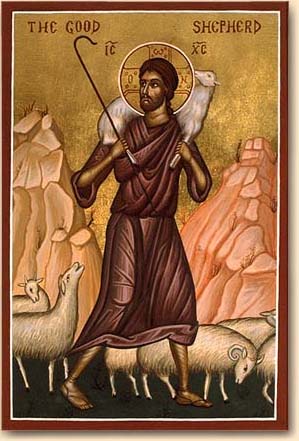
icon-of-the-good-shepherd

Easter 3

Christ the Good Shepherd

John 10:11-16

There’s a common term used by conspiracy theorists and fringe political groups to describe the helpless masses.  They call them “sheeple.”  I don’t think I need to translate too much for you.  They’re saying if you’re not like them you’re just a dumb follower.

            We’re almost two thousand years removed since the last drop of ink was scraped into the final page of the Scriptures, but we still use sheep as a derogatory accusation of fools who are susceptible to any predator and at risk of following the herd off the precipice of dangerous summits.  “Wake up sheeple!” is the common refrain from those who claim to be in the know.  Their message is quite simple:  Quit being sheep!

Unfortunately just as you can’t tell an actual sheep to change its breeding, so you can’t order a man to change their nature.  In our lessons Jesus leaves us no room to escape this metaphor—we are all sheep.  Even those who think they have awakened and are now free thinking non-sheeple should realize they have listened to someone’s voice to arrive at their conclusions.  You see for Jesus the question is not a matter of the degree of our sheepyness, but instead a matter of who is our shepherd.

sheeple

Everyone listen’s to a particular shepherd’s voice.  These voices shape your view of the world and of life.  In our relativistic culture people will listen to all kinds of shepherds.  They’ll do this even when they contradict one another.  They think they can pick and choose what is good for them.  Yet, like sheep we like things that are not good for us.  We blithely go with the crowd and chew on spiritually poisonous food.  The Good Shepherd has lead us to still waters and green pastures.  We have all that we need in his Word for our health, but like stubborn sheep we want to ignore what is good for us.  We reject how God has ordered the creation for us and for our good.  When we do not like that order we say we’ll redefine it—like we see with marriage.   Please don’t think that’s just condemning the issue of homosexual behavior—marriage was redefined a long time ago in America with cohabitation, no-fault divorce, and pornography claiming to be artistic expression.  Hirelings have mislead and abandoned the sheep when all kinds of spiritual dangers of the wolf—that is the devil—are spotted on the horizon.

We keep hearing that on our horizon is a more secular America.  Some think secularity means godlessness, but that’s not necessarily true.  Plenty of people live in a secular way and adorn it with a deity of their fancy.  Secular simply means “in the moment.”  To be secular is to be only concerned with the present.  The world’s secularity is a symptom of our own sheepyness.  How many of us catch ourselves worrying more about the bills and balancing our time then we spend time in prayer?  Sheep only live in the moment with no thought to the future and they don’t learn from their past.  Sheep only worry about the blade of grass before their nose and the stream yards away.  They follow the flock whether or not their shepherd is leading them in a trajectory that leads to death or life.  Sheep are the most secular of animals!  They can’t live anywhere, but in the moment.

That is us, says Jesus.  How many terrible things have we swallowed because it seemed tasty at the moment?  How many things have we accepted because without admitting it we just wanted to fit in and follow the larger flock—to be in with the in-crowd?  Adulteries of mind and body, covetousness that leads to discontent and theft, self-righteousness which chokes the Word of Christ from us, pride which smashed our neighbor and leaves scars in the back of the poor weak lambs we’ve climbed over to get what we want.  We are indeed sheeple!

Where do we go from here?  We need a good shepherd and all others have failed.  They abandon the flock when things become too dangerous or they’re devoured with the rest by the wolf.  That is why God has sent us the Good Shepherd of our souls Jesus.

Jesus is the “I am” Good Shepherd.  Did you notice the divine name there?  “I am, “Yahweh”, the Good Shepherd.”  Jesus is the God enfleshed shepherd who promised by the prophets to come himself to guide and to save his sheep.  Jesus certainly had Psalm 23 in mind when he called himself the Good Shepherd, but he also knew his promise in Ezekiel 34.  “For thus says the Lord God:  Behold, I, I myself will search for my sheep and will seek them out.”  Jesus is saying that this is he.  He is the Lord God seeking his sheep and they will respond to his voice.

Jesus emphasizes he is a shepherd in his own unique class.  He’s the divine shepherd—the greatest shepherd.  He does not say, “I am like a shepherd who is good” as if he belongs to the class of other shepherds who are good at their vocation.  He is the Good Shepherd.  All other shepherds claiming to lead man to God are evaluated by comparison to Jesus.  All the hirelings abandon you and lead you away from Jesus.  The Good Shepherd has given you pastors, under-shepherds, and they are only worthwhile if they deliver you to the Good Shepherd.

Christ calls himself the Good Shepherd.  We should ask then “What makes Jesus the Shepherd good?”

Jesus states the reasons clearly.  The Good Shepherd unlike the hireling owns the sheep.  He’s in fact their creator.  Therefore when danger comes he does not abandon his flock, but stays and protects them.  Even more, he stays, and is willing to lay down his life for the sheep.

crucifix sun background

What good is a dead shepherd?  If the wolf kills him then his flock is left there with the predator.  This is perhaps where the metaphor breaks down a bit, but there’s a great paradox that happens here.  Instead of the sheep being the blood sacrifice for the shepherd, the shepherd becomes the sacrifice for the sheep.  Of course the disciples and all who heard this would not have a clue what Jesus meant by laying down his life until his crucifixion.  Afterwards they knew as you know now that Christ paid the penalty for all our sheepy ways.  He has stood in the gap and suffered the penalty for all the things that tempt us to go astray and flirt with eternal death.  The wolf—that ancient evil one—bit the shepherds heel and did his worst and for a fleeting moment it looked as though the sheep were all alone with their salivating enemy looking for his next snack.


Magdalene at Tomb Just a verse after our lesson Jesus says, “…I lay down my life that I may take it up again.  No one takes it from me, but I lay it down of my own accord.  I have authority to lay it down and I have authority to take it up again.”  This makes this shepherd the greatest of them all.  Christ saved you by allowing the wolf to take his life instead.  It would do you no good to be left alone with a dead shepherd.  So the Good Shepherd lays down his life to defeat the wolf, sin, and death.  The he takes his life up again to nurture, protect, defend and lead you forever.

You know the Good Shepherd by his actions for you.  He is the shepherd who when you stand condemned forgives you.  This is the shepherd who time and again follows you when you’ve gone astray and picks you up, bears the burden of you, and restores you to the flock of God.  When you’ve followed other voices, when you’ve lived for the moment and forgotten where the shepherd is guiding, he’s there with his rod and staff to protect and lead you home.  This is the shepherd who has baptized your filthy sin ridden wool and made it white as snow.  This is the shepherd who feeds and nurtures you from his own body and blood week in and week out.  This is the shepherd whose voice speaks to you the peace and blessing of God the heavenly Father.  This is the shepherd you have grown to trust and are still growing to trust.  This is Jesus, the Good Shepherd leading his sheep to rise from death and to live eternally by still water and rich pastures.  It’s never been so good to be sheeple!  In Jesus’ name, amen.

SDG—Rev. Eric M. Estes

Posted in Easter, One Year Lectionary, Sermon | Leave a comment

Seeking Allah, Finding Jesus

For the next two weeks our Adult Bible Study is viewing and discussing this talk by Dr. Nabeel Quereshi.  Dr. Quereshi discusses how his historical investigation of Christianity led to his conversion from Islam.  Attached below is also a handout from a Bible Study Pastor Estes taught on Christian Apologetics.  The handout covers the basic historical evidences of Christ’s resurrection as well as the most common naturalistic explanations for Jesus’ empty tomb and Christian apologetic responses to them.  Many of the points from that handout are discussed in further detail in Dr. Quereshi’s presentation.

Bible Study Resurrection Handout

Posted in Bible Study, Video | Leave a comment

Sermon: Easter 2 John 20:19-31

 Easter 2

John 20:19-31

“That you may believe…”

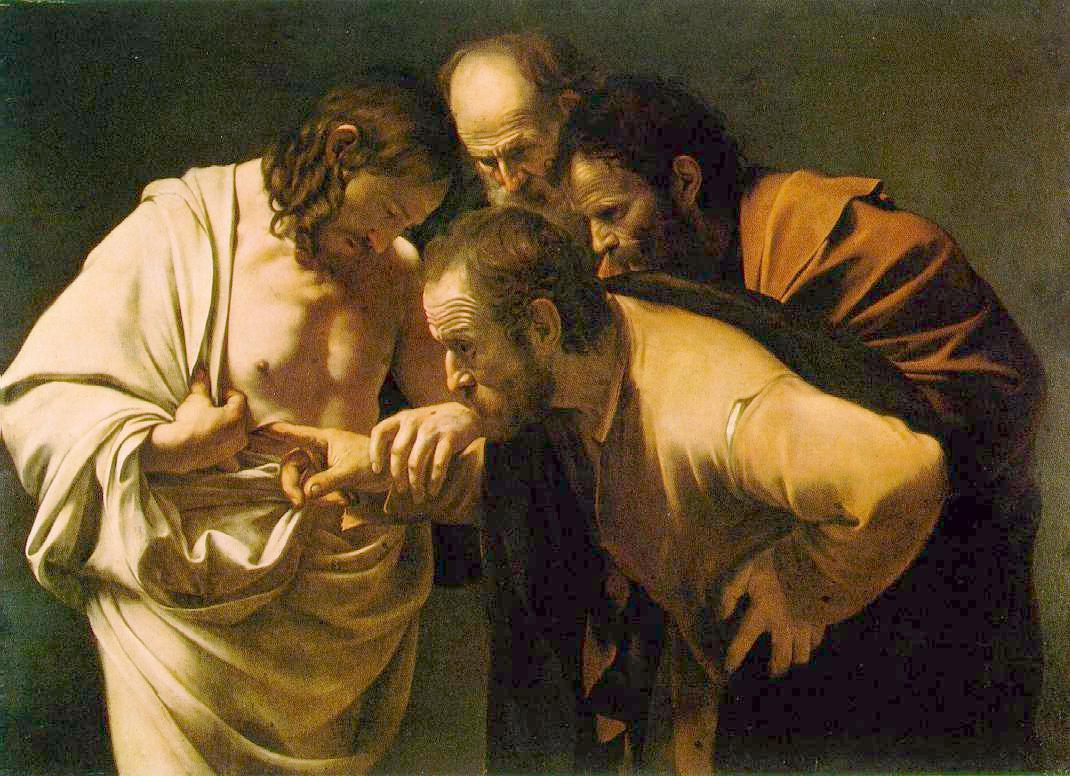
Thomas and Jesus


Sermon Audio:  

For the video and Bible Study material mentioned in the audio version of this sermon please click here.

“These things are written that you may believe that Jesus is the Christ the Son of God, and that by believing you may have life in his name.”

John 20:31

In the name God the Father, the + Son, and the Holy Spirit, amen.

Christianity is the only religion that can be disproven by a single piece of evidence.  If it is historically proven that Jesus of Nazareth who suffered under Pontius Pilate, was crucified, died and was buried, is not risen from the dead then the Christian religion is null and void.  If Christ is not risen it means Christianity has no power to forgive you, no power to strengthen you, no message of hope for you, and it can’t lay claim to having the truth.  For if Christ is not risen then the entire Christian religion is based on a lie.

The gospel spread with this simple and utterly profound message for the nations to hear that Christ died for sin once and for all, and God has vindicated Christ by raising him from death.  The Apostles unbendingly taught that Christ died for our trespasses and was raised for our justification.  On the cross he paid the wages of sin—death.  There on the cross Christ won the forgiveness of your sins.  In his resurrection he gives you not only a vindication of who he is as God in the flesh, but assurance that you are truly declared righteous by God.  Christ’s resurrection means that all he said of himself and all that was said about him by the prophets is true.  Uncover his bones, disprove his resurrection and then Christ is a liar and the Scriptures are unreliable.

You dear Christians probably don’t like hearing the title Christ and the noun liar in the same sentence.  You confess weekly that the forgiveness of sins, the resurrection of the body, and life everlasting are truth.  It might be hard for you to think that just a single piece of evidence to the contrary could undo your entire faith.  Is the Christian faith then a tenuous house of cards?

Sadly, a lot of what is proposed as proof of Christianity is exactly that—tenuous.  You will hear Christian leaders invite people to try Christianity on for size and see if it “works.”  What they mean is for you to see if it makes you happier, more hopeful, more moral, or more content.  In their mind if it does any of those things then it must be true.  American Christianity has been tempted to trump up some therapeutic value to the Christian message in order to make it more appealing to others.  Christian leaders preach the comfort of the gospel, but they forget that it’s comforting because first it’s true.  A lot of things whether they are true or not can make someone happier, hopeful, better behaved, and content.  Whether I receive some emotional or psychological benefit really does not prove something is true.  I can get that from a good ballgame or a good meal or even a false belief.  What matters in Christianity is whether or not its truth claims hold water.  If they do then consequently there is great comfort!

Thomas got this.  As much as it might have been nice to hear that Jesus was risen until he knew for certain Thomas would not be comforted.  He needed to know it was true.  Firstly, don’t get me wrong about Thomas’ experience.  He is not a positive example.  Before seeing Jesus he was not a doubter like we usually call him.  Jesus says he was flat-out disbelieving.  Jesus’ words to Thomas are reproachful, “Have you believed because you have seen?”  Thomas had rejected the gospel preached to him by the other disciples.  In his obstinate refusal to believe their word he was making them out to as liars and the gospel message as fraudulent.  Did he think the nine of them were just pulling his leg with a mean joke?  Did he think them mad or hallucinating?

Modern skeptics think some of those things.  There are alternative explanations they’ve come up with to explain away the empty tomb.  Did you notice that?  They agree there’s an empty tomb, but how it became empty is what they argue over.  None of these skeptical arguments stand up to biblical and historical scrutiny.  For example one theory is that Jesus didn’t die on the cross—he swooned instead.  The skeptics act as though Roman soldiers could have failed at their job of executing a prisoner.  History is against them.  There are no accounts of a completed scourging and crucifixion where the victim survived.  Even the scourging was so traumatic it often killed the recipient.  Such theories have been proven time and again to be conjectures that ignore the evidence of history.  Some have even gone as far as to claim that Jesus must have had a twin brother.

If there is one positive thing we can learn from Thomas is that he understood well if the resurrection is historically true then there is great comfort and one ought to repent of their faithlessness and believe.  Yet, if it is not true and the other apostles’ were just pulling his leg one should drop the gospel message like a bad habit.  Thomas did the former.  The message of the disciples’ is true.  He had all the evidence standing there in front of him in the flesh of Jesus.  Christ is risen!  Thomas’ only response is one of confession and worship, “My Lord and my God.”  Up until that moment Thomas had not doubted that Jesus was a man.  Risen from the dead now Thomas knew Jesus is God in the flesh.

“These things are written that you may believe that Jesus is the Christ the Son of God, and that by believing you may have life in his name.”  “Blessed are those who have not seen and yet believed.”  Those exhortations of St. John and of our Lord Jesus are for you my dear brothers and sisters in Christ.  Relatively speaking from the perspective of time only a few people could be eyewitnesses of Jesus’ resurrection.  He appeared to the women, the eleven remaining disciples, and to upwards of five hundred people before his ascension.  Only a few could be witnesses in the strictest sense of the word, but the message would belong to everyone.  Their eyewitness message was from God himself concerning the essential thing he did for the world.  The apostle’s realized they had a great calling and it resounded always in their preaching, even Thomas when he went to India as a missionary as tradition holds.  They preached:  “But God raised Him on the third day and made Him to appear, not to all the people but to us who had been chosen by God as witnesses, who ate and drank with Him after He rose from the dead. And He commanded us to preach to the people and to testify that He is the one appointed by God to be judge of the living and the dead. To Him all the prophets bear witness that everyone who believes in Him receives forgiveness of sins through His name” (Acts 10:40–43).

Dear saints in Christ do not let apathy or disinterest to the historical evidence of Christ’s resurrection weaken your faith.  Equip yourself with this message.  I again invite you to Bible Study where you can learn more.  Listen with discernment, study the word, and hear the good news preached by the apostles that Jesus is risen from the dead.  It is true and therefore you have the greatest comfort.  Your sins are forgiven.  You have life in his name.  You need to look no where else to be validated—you are approved by God in Christ Jesus.  He has given his preachers authority to give that comfort to you—your sins are forgiven!  Christ is risen!  He is risen indeed!  Alleluia!  In Jesus’ name.  Amen.

SDG—Rev. Eric M. Estes


Posted in Easter, One Year Lectionary, Sermon | Leave a comment

Sermon: Easter Day Mark 16:1-8

Easter Day

Mark 16:1-8

“Death’s A Gardener At Best”

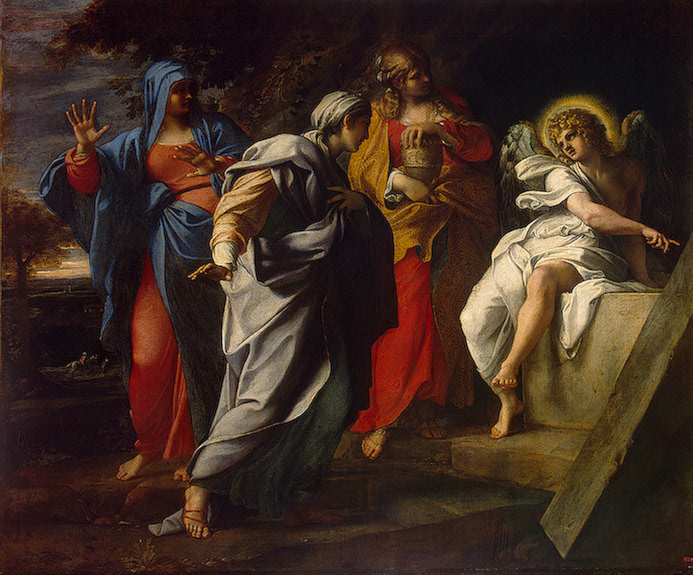
Mark 16.1-8 resurrection-carracci

Jesus speaking of his resurrection before his crucifixion said, “Unless a grain of wheat falls into the earth and dies, it remains alone; but if it dies, it bears much fruit.”  The disciples at first thought he must have been speaking figuratively.  No one expected him to rise from the dead.

The women in our gospel lesson this morning were coming to anoint a dead body.  It did not occur to a single one of them to remark, “Say, remember how Jesus said multiple times that he would be tried and crucified and on the third day rise from the dead?  Say, it’s the third day right now, let’s go check it out.  It can’t hurt.”

Not a single one of them, not the women nor the disciples, thought he would rise.  There goes the argument of the moderns who say ancient cultures were easily duped or would believe any foolish thing.  They knew death was the end.  Even the Jews who believed in a resurrection didn’t believe that just one man would rise by himself.  They were waiting for a last day when all would rise, not just a risen Messiah.

Skeptics will look past the resurrection as some superstition of archaic people.  The women and the disciples and many of the ancients did what many modern skeptics will not do.  They looked at the evidence that was beyond their reason or understanding and were intellectually honest enough to be challenged by it.  They let the evidence bring them to the conclusion that Jesus rose even when the evidence was scrutinized.  The skeptics of our day and days past come up with all kinds of theories, but not one of them stands up to biblical and historical scrutiny.  Some claim that Mark and the other gospel writers knew they were writing a myth, but all the evidence says otherwise.  Mark in our gospel lesson for example made sure to name the eyewitnesses—three women.  It’s even more interesting that Mark would not have chosen women if he had really wanted to convince people since in ancient cultures the testimony of women was not accepted as reliable.  Yet, Matthew, Mark, Luke and John ignore the biases of their world and report that three women were the first eyewitnesses and why?  Because, that was the truth.

That’s enough about skepticism.  Look at the women at the tomb today.  They go mourning to anoint Jesus’ body.  They expect a heavy stone, a smelly tomb and a frozen corpse.  Instead they find an open grave, empty tomb, and an angel with a divine message: “You seek Jesus of Nazareth who was crucified.  He has risen; he is not here…But go, tell his disciples and Peter that he is going before you to Galilee.”  Then Mark’s gospel ends in an unexpected way.  He says they were trembling, astonished, and afraid.  This experience was so strange it scared the wits out of them.

Fear is the last emotion we think of on Easter, but maybe we should from time to time.  If Jesus is risen from the dead think of what this means.  It means someone has done the impossible, they’ve defeated the one great equalizer—death.  It means that everything that he said about himself is true.  He is God in the flesh.  He is the Lord of heaven and earth.  He is the sacrificial victim who received your sin and death and put an end to them both in his body.  He will come again just as he said he will!  If this is true, and it is true, we should tremble at the thought.  The man who died on Good Friday is God.  God came down and identified with us and bore what we could not!  He has overcome everything that afflicts us day in and day out.  Pain, sorrow, death, loss, sin, loneliness, all have been taken into himself as the God-man and overcome by the power of his resurrection.

“Unless a grain of wheat falls into the earth and dies, it remains alone; but if it dies, it bears much fruit.”  Do you realize what Jesus means here?  He’s saying that at one point in time death was an executioner, but now that he is risen from the dead death can only be a gardener.  Jesus, the grain of wheat, has fallen into the earth and died and sprouted forth with much fruit.  His resurrection bears with it the fruit of all resurrections that will happen on the last day.  Your resurrection!

Though this gospel ends with women in fear there is a wonderful word of grace in it.  The angel reminds the women that Jesus told them this would happen and that they should go and tell the disciples to go to Galilee.  So where’s the grace?  Did you notice, that the angel especially makes sure they tell Peter.  Peter—the denier of his Lord.  Of the eleven disciples left he had screwed up royally.  He had sinned terribly.  If the women had come back and said the disciples are to go to Galilee Peter would have not gone. He would not think himself a disciple, but Jesus applies his grace to Peter from the message of the angel.  “Peter, yes you sinned, yes you failed big, now come to me and be mine again.”  Jesus would pour on his grace forgiving Peter three times for his three denials.

That grace is yours too brothers and sisters.  The inner skeptic in every human heart that would deny the wonder of this day is invited by Christ’s forgiveness to come and proclaim that He is risen!  His forgiveness is there for you and here is the wonder that we have in all this.  The greatest sinners, the big screw ups like Peter, become the deepest in repentance and the ones who understand all the more the sweetness of God’s grace and the awesome message of the resurrection.  The resurrection means Christ’s paid the penalty for our sin on the cross in full.  When a prisoner serves his sentence he leaves the prison a free man.  Jesus paid our penalty and we know it was paid in full because he walked from the grave a free man.  He gives you the freedom he won for you!  He gives you life and forgiveness in his name.

This means anything that life can throw at you cannot be the end of you.  Loneliness cannot end you for at the resurrection you have the friendship of all the saints in heaven to look forward to.  Sickness cannot end you for you have the promise of a fully restored and resurrected body that will live forever.  Death is not your executioner; he’s a gardener at best.  You have been planted into the ground with Christ in baptism and you have been raised in Christ’s resurrection—all that you have ahead of you is fruitfulness.  For you are the spoils of Christ’s great victory and planting.  You are his harvest in the forgiveness of your sins.  A blessed and happy Easter to all of you.  Christ is risen!  He is risen indeed!  Alleluia!


SDG—Rev. Eric M. Estes

Posted in Easter, One Year Lectionary, Sermon | Leave a comment

Sermon: Easter Sunrise Isaiah 25:6-9

Easter Sunrise

Isaiah 25:6-9

“The Party’s Not Over”

Magdalene at Tomb

            The first Easter began much more subtly and somberly then it does now that we have the entire picture.  It began graveside and with the tears of Mary Magdalene.  Easter began with heavy hearts and heavy steps.  We know about death and burial.  We have been there.

This morning we’ve come with happy hearts and light steps because we know that Christ is risen!  You’ve likely made some preparations for this day.  Easter is day of feasting.  The 40 days of Lent are over and now we celebrate Christ’s resurrection with food and drink.  What’s on your banquet table today when you arrive home:  ham and turkey, sweet potatoes and pies?

I hope I haven’t distracted you by considering the tasty morsels that await you, because really the greatest table is spread for you at this moment and the best is yet to come.  In our Old Testament lesson Isaiah invites us to the feast of Zion.  This is the feast of Yahweh’s Easter victory!

The women went to the tomb thinking they would meet mortality.  They thought they’d be faced with death.  We would think the same.  Death in this world is so final.  We submit ourselves to the fact that we all will die sometime.

What did the women meet at the grave instead?  An empty sepulcher and the Divine message sent from angels, “He who you seek who was once dead is not here.”  The grand discovery is Christ is not dead.  He is risen!  That fearful truth is only trumped by one greater truth spoken from the lips of our Lord, “Because I live, you will live also!”  Has it occurred to yet as you are still waking up this Easter morning that the same thing that happened to Jesus will happen to you?  Your body will leave behind an empty grave too!

Break out the champagne!  Bring out the finest wine and food!  Isaiah provides this feasting for us today.  Yahweh God, the Lord Jesus, the Holy Spirit will gather all his one Holy Christian Church to the Mt. Zion of the new heavens and new earth.  He has a rich feast waiting, greater than any Easter before.  Though I’m sure there will be real food and real drink in heaven of the kind never matched here on earth what Isaiah is really getting at are the spiritual blessings.  Christ is risen, his death on the cross where he bore your sins is now vindicated.  He has victory over death and that victory becomes yours too!

You see in that day the Lord is going to remove the veil that covers all people.  The veil Isaiah speaks of is the kind of veil people would use to cover their face in shame.  Think of newscasts where cameras will show an accused convict trying to cover his face with his jacket as he runs to a car.  The T.V. audience spread across the country rarely feels sorry for the poor bugger.  They want to see his face!  What we forget is that we may not have anything on our conscience that is so publicly shaming that we should hide from our fellowman, but before God we ought to be like Adam in the garden; hiding the moment he hears God’s footsteps.  We have all sinned and have been seen.  In our most honest moments we are well aware of that veil of self-justifications and happy faces that we put up so that we can’t really be known in our weaknesses by others.  We are known by God though.  He knows how our sin has covered us in a veil of death; a death we deserve for our sins.

We either repent and confess our sins or we hide behind the veil.  We will even try to make God a part of this veil, thinking that that we’re really not that bad off and God will reward good intentions even if there is no follow through.  Likewise we’ve replaced the Creator with Darwin so we can excuse any animalistic tendency in ourselves.  If we see it in nature we think it must be approved for man and give no more thought to our moral worth and what it means to have been created in the image of the Divinity.  Without God we enter a spiritual and cultural vacuum where honesty and fairness are seen very little.  We become convinced that any means can justify an end of our choosing.  Greed and our desire to fulfill our most base pleasures win the day.

Can anything or anyone change this or is the party over?  Isaiah in our chapter prior writes of the judgment of God against the nations.  It can be summed up this way, “The party’s over!”  “The mirth of tambourines is stilled, the noise of the jubilant has ceased, the mirth of the lyre is stilled.  No more do they drink wine with singing; strong drink is bitter to those that drink it.”  If we were left to our sin and God’s condemnation we would have no reason to feast, no reason to celebrate.  There would be no reason to sing.

Yahweh could rightly chastise and judge us severely.  Instead, he does Easter—God’s gracious doing through Christ.  Once crucified and dead—bearing all our sins upon the cross—Jesus carries away the shameful veil of death from our faces.  He forgives your sins, my sins, and the sin of the whole world and makes you whole and clean.  He is risen!  He is your victor and guarantor that you can look God and your fellow man in the eye knowing you are clean in the sight of God.

Isaiah’s announcement today is that the party’s not over!  We are welcomed to the feast where death is swallowed up forever.  In that day when we rise from our graves death will be no more.  God has swallowed up what swallowed us—the graves will be empty—food, wine, and song will abound.  We think of death as the end, but Easter tells us that death has an end—the Resurrection of Jesus!  Death’s power is futile—it is conquered!

So God through Isaiah gives us a song to sing.  A future song, “Behold, this our God, we have waited for him, that he might save us!  This is the Lord; we have waited for him; let us be glad and rejoice in his salvation!”  It’s a future song, but Isaiah gives it to us that we might start practicing now.  That’s what Church is all about—receiving the salvation of the Savior.  He gives your rich food and rich wine to drink.  His body and blood, in, with, and under the bread and wine or true food and true drink for the forgiveness of all your sins.

The world thinks it knows about “feasting.”  Our commercials invite us to dine at the ritziest restaurants and taste the most succulent food of our own creation.  But such feasting ends.  Easter morning is an eternal feast, an eternal victory and never ending celebration.  The feast is spread for you today.  Jesus has defeated sin, death, and Satan himself, making salvation and life with God ours.  What better picture of this life than the enduring feast of victory with God, who blesses us with his finest as a gift!  With the veil removed and the covering swallowed, let the feasting begin and never end in him!


SDG—Rev. Eric M. Estes

Posted in Easter, One Year Lectionary, Sermon | Leave a comment