Sermon: Good Friday 2 Corinthians 5:14-21

This sermon was preached by Chaplain Rev. Graham Glover CPT USARMY.  Graham is a member of Lutheran Church of the Redeemer and serves the soldiers of Fort Benning, GA.

IN NOMINE X JESU

Dear brothers and sisters in Christ Jesus, we gather tonight in a barren sanctuary. The altar is stripped and no sacred vessels remaining. The atmosphere is muted, with noting festive or inviting about it. The music is subdued. The lights are dimmed and will become more so as the night continues. We left Maundy Thursday in silence. Tonight’s service began the same way. And we will leave this evening with nothing emanating from our lips. It is, as our bulletin notes, a service of darkness. Complete and utter darkness. For those who share our faith, there is no more solemn day of the year than this. It is literally a day of death. We refer to it is Good Friday, but nothing about it seems good. It feels miserable. It looks disturbing. And on its own, it most assuredly would have been the worst day in the history of creation.

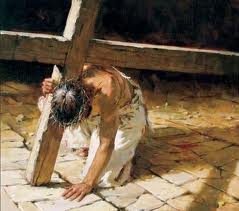
For today a rabbi from the town of Nazareth was executed on a cross. He was mocked, beaten, spit upon, and ridiculed. He was treated like the dregs of society – classified an outlaw and heretic. But he wasn’t like most criminals of his time. He didn’t steal, cheat the Roman government of its taxes, murder, or incite riots. Nor were his words or actions heretical. He knew the Word of God – the Law and the Prophets, interpreting them with ease from the time he was a child. He was a man of peace, who proclaimed a message of Good News and hope to those who put their trust in him. He healed the sick, calmed the wind and rain, and raised the dead from the grave. He was, by all accounts, a phenomenal preacher, even when he taught in parables that many struggled to understand. He came from humble means. His father a carpenter. His mother the highest example of righteousness the Scriptures give witness to – beginning when she assented to a decree from the angel Gabriel and continuing through her son’s death and beyond. By any reasonable standard, this man was completely undeserving of today’s events. Yet this rabbi was betrayed by one of his closest confidants for a few pieces of silver. Afterwards, he demanded no immediate retribution be taken against this disciple. When asked by the high priest and local governor if he was who others proclaimed him to be, he answered: “You have said so”, all but ignoring the interrogation of these powerful men. The crowds, both religious and secular, demanded this man be crucified – the ancient Roman custom of capital punishment – a practice that was as inhumane and barbaric as one might suspect. It was pure torture, for hours on end. And the crowds were so determined that this miracle worker should die, that they assented to the freedom of a hardened criminal and revolutionary named Barabbas. The crowds’ anger was crystal clear, “Let him be crucified!” they shouted, “Let him be crucified!” They were so impassioned about this that they declared, “His blood be on us and on our children!” Struggling along his way to the place where he would be crucified, a location called Golgotha (which means Place of a Skull), he was struck with a reed and stripped of his clothes. His head, profusely bleeding because of a crown of thorns thrust violently upon it, must have been hard to lift as he cried out in darkness, shortly before breathing his last, “Eloi, Eloi, lema sabachthani?” that is, “My God, my God, why have you forsaken me?” At which point the curtain in the temple was torn in two, from top to bottom. And the earth shook, and the rocks were split. The tombs also were opened. And many bodies of the saints who had fallen asleep were raised. Afterwards, his side was pierced with a spear, from which blood and water flowed. His death was real. Violent, dark, and contemptuous – this rabbi was no more. He was dead. The kingdom of God he promised appeared to be dead as well. And tonight as we gather, we recall this man’s death. We remember this day, in every agonizing detail. In its misery and solemnity, we remember. And still we call it good. We call his death good. Barbaric and horrific as it was, it remains in the language of our faith – good.

But what is it about today that is good? Can this death possibly be a good thing? And why are we followers of this man gathering tonight to remember these events? We’re not here simply to recall the miracles and sermons of this rabbi. We’re not here to extol him as our example to follow. He was undoubtedly a good and righteous teacher, but our faith is not based only on his teachings. For thousands of years God’s chosen race waited for him to appear. He was prophesied about from the moment our first parents sinned in the Garden of Eden. Prophet and King alike anxiously anticipated what he would do. Through numerous trials and tribulations, the people of Israel looked forward to his arrival. And then he came. Born in a manger. Born without fanfare. Born without an earthly throne. His life defied so many expectations. His deeds continue to confound. And he died. He died like any other man. He died like a stricken, smitten, and afflicted apostate – rejected by all. He hung on a cross – with his Blessed Mother looking upon his frail and lifeless body – and we call it good.

Yes, the death of this man is good. It is good because as the apostle Paul notes in his 2nd letter to the Corinthian church, “for our sake he” [that is God] “made him to be sin who knew no sin, so that in him we might become the righteousness of God.” Were it not for the death of this man, our death would be permanent. When our lives on this earth are over, nothing else would remain. As for this world, we would have nothing to hope in, nothing to rejoice over, nothing to rely on – except our own failures and inadequacies. Our sin – our inability to perfectly keep the law of God – would ultimately warrant each and every one of us eternal death, eternal separation from God. This is why today is good. For the rabbi whose death we remember this day was no mere mortal. He was the Son of God. He is God himself, in the flesh. And he died. Yes, God died. He suffered and died on the cross. And this we celebrate. We celebrate the death of God. And it is good. It is, as this man said on this day, “Finished”.

Finished? Yes. Over? Not a chance. Here the words of Dr. Luther are appropriate: [We] “must know that if God is not also in the balance, and gives the weight, we sink to the bottom with our scale. By this I mean: If it were not to be said [if these things were not true], God has died for us, but only a man, we would be lost. But if ‘God’s death’ and ‘God died’ lie in the scale of the balance, then He sinks down, and we rise up as a light, empty scale. But indeed He can also rise again or leap out of the scale; yet He could not sit in the scale unless He became a man like us, so that it could be said: ‘God died,’ ‘God’s passion,’ ‘God’s blood,’ ‘God’s death.’ For in His nature God cannot die; but now that God and man are united in one person, it is correctly called God’s death, when the man dies who is one thing or one person with God.”[1]

So who is this man? Who is this rabbi? Who is this one that died that we call the Son of God, nay, God himself? He is none other than the Christ – the promised Messiah of Israel. He is Jesus. He is our Savior. And his death has redeemed us all. His death has saved us from ourselves. His death means life – life eternal. So it is good. It is great. And on Sunday, it’s only going to get better.  Amen.

SOLI DEO GLORIA

Rev. Graham B. Glover


[1] Of the Councils and of the Church.


Posted in Lent, One Year Lectionary, Sermon | Leave a comment

Sermon: Maundy Thursday John 13:1-15

In the name of the Father, Son, and Holy Spirit, amen.

christwashingfeetofapostlesTonight we begin the first of three holy days leading up to Easter. On these nights we will meditate on what Jesus has done to save us. You will remember that the Son of Man came not to be served, but serve and give his life as a ransom for you. He did this by going to cross as the Lamb of God who takes away the sins of the world. He did this by bearing the beatings, the trial, and scourging so he could be placed on the cross to be forsaken by God the Father so you don’t have to be. For these next three days remember he did all this so that you can hear the joyful message that he rose on Easter morning.

We hear of the Lord rising in our gospel lesson this evening. It’s not the rising you normally think of and in fact this little detail at first seems so insignificant. John recounts that in the middle of the supper Jesus rose from the table. He rose from reclining with the disciples, took off his outer garment and wrapped a towel around his waist.

Why did he rise?  All of us here know why.  He rose to wash the disciple’s feet, but this subtle detail exposes that something was really amiss.  Etiquette dictated that one’s feet were to be washed before supper, not at the end or the middle of the supper.  That Jesus stood to do this after the supper had begun exposed his guest’s impropriety.  Yet, he had more than a lesson in manners to teach them.

This is the point I’d like us to take home this evening. Jesus rose to serve his disciples when they refused to serve.

Many of us feel a bit repulsed at the thought of touching another persons sweaty feet. Imagine sweaty sandaled feet with a day’s worth of dust and grime to boot. Washing feet was the work of servants and slaves, but this was a private affair. There were no servants or slaves among them, or at least that’s what the disciples thought. Did they at first take their places with bated breath hoping they would not be the one the Lord would choose to do the humiliating chore? We don’t know, but what we do know is that not a single one of them volunteered.

The basic principle Jesus is teaching is easy to understand. He explains it himself. The one whom they (and we with them) rightfully call Lord and teacher made himself the servant and slave by washing their feet. They likewise are to wash one another’s feet. This was not to become a ritual, but a pattern. Jesus rose, in order to bow down and serve, cleansing and washing their crusty toes. His disciples are likewise to serve one another.

Peter was incensed at first. (That’s typical of Peter). The sight of his lord and master humiliating himself this way was too much. Once Jesus gently corrected him Peter asked for his hands and his head to be washed too. (That’s also typical of Peter.  He was a man given to extremes).  On this evening the disciples were only getting a glimpse of the entire lesson and significance of this service. Jesus told Peter, “What I am doing you do not understand now, but afterward you will understand.” The “afterward” Jesus is talking about are the days following his death and resurrection. Then and only then would Peter and the disciples understand what Jesus meant by this service. Only then would they really know what he meant when he said, “you are clean.”

We should take pause here and let this sink in for a moment. What is most troubling about Jesus’ taking on the form of a servant is not his charity, other men are charitable. Nor is it troubling for him to ask us to love one another. Other men say that and our world now parades love like a slogan with little understanding of love’s source in God. What should trouble us is what Jesus says later, “Love one another as I have loved you.” Where it once was “Love your neighbor as yourself”, it’s now “Love as Jesus has loved you.”

Jesus loves you to death. He loves unto death. Jesus loves to your advantage at his disadvantage. His loves gives to your complete gain and his total loss. Jesus loves, even when his love is abused and taken for granted. The same Jesus said to follow his example, to love like him.

The love that sinners offer is much different. We love others, but with stipulations. Certain work is too lowly and too unsightly for us. We like to love from the position of authority and where we have some control. Even the least of us gives from our riches and not our poverty. We’ll love and give to others when we have the free time, the extra rest, or the surplus funds to do so. We are extremely concerned with having enough in reserve for ourselves, so we won’t let our love completely deplete us.

christ-bearing-the-cross Jesus’ love lead him to completely deplete himself of life and breath on the cross. He did not give to us from the place of authority or control, but instead from the place of weakness and death. He gave you his riches by becoming impoverished for you. He does not just forgive your sin he becomes your sin on the cross. He does not just take away your death he becomes your death on the cross.

Jesus example is one of reckless abandon and reckless love. He abandons himself to the Father’s will alone. He drinks the cup the Father has poured for him and faithfully trusts that his Father will deliver him. Jesus abandons himself to your poverty of sin and death to save you. It really can’t be put any better than St. John’s gospel in a nutshell, “For God so the loved the world that he gave his only begotten son that whoever should believe in him shall not perish, but have eternal life.” Or St. Mark’s, “For the Son of Man came not to be served, but to serve and give his life as a ransom for many.”

Confronted with the reckless love that would rise once more from the table and go to the cross we know we cannot find such charity in ourselves—or the world around us. This love must first bring us to repentance. Like the disciples who were first shamed by their master rising and stooping to serve, so we are brought to our knees in worship for Christ’s loving service. Yet, look at the kindness by which Jesus serves. “You are clean.” He tells Peter. So, He also tells you.

We spent our Lenten midweeks remembering our Baptism into Christ. Submerged under all this talk of foot washing is also a nod to Baptism: “If I do not wash you, you have no share with me,” Jesus says to Peter. The washing Jesus is referring to here is not a foot bath, but the washing of regeneration and renewal, a washing of water and Spirit with the Word. In Baptism, Jesus again stoops down to us, the Holy One reaches down to wash the filthy and crusty sinner. Unless we are washed by Jesus, we have no share with Him. Only He can cleanse you from sin, only He can make the sinner clean.

At this supper Jesus takes bread, breaks it, gives thanks, and says “This is my body given for you.” He takes the cup filled with wine and says, “This is my blood of the new covenant shed for you.” Jesus, the servant foot washer, sheds new light on the Passover meal. He institutes a new Passover, where we are delivered not by the blood of goats or of lambs, but of his body broken and his blood shed on a tree. This is the Lord’s Passover where the Lamb of God who takes away the sin of the world is received in the mouths of the saints in His true body and true blood for you to eat and to drink.

From this Supper of His Body and Blood, faith toward Christ and love for one another is given and strengthened. We always pray that this salutary gift would strengthen us the same in faith toward God and in fervent love toward one another. Jesus loved us to death, giving His Body and Blood on the tree of the cross, lifted up for the life of the world. He loves you, washing you in the water of Baptism, giving you the bread of His Body, the wine of His Blood, all of it as gift to you – undeserved, unmerited, unearned, gratis, by grace.

And in that love, you are given to love one another, reflecting to each other the love that you have received. The world cannot see Jesus’ love. They can hear it, they can taste and see that the Lord is good. But they can’t see it. What they can see is you. “This is how the world will know that you are my disciples, that you love one another”

He gives His life—all of it to the very last drop. He gives you a pattern for life – love. This is the Lord’s Passover. In the name of God the Father, Son, and Holy Spirit, amen!

SDG—Rev. Eric M. Estes

Posted in Lent, One Year Lectionary, Sermon | Leave a comment

Sermon: Passion Sunday John 12:12-19, Matthew 27:11-54

Passion Sunday

George Burns once said that the key to a good sermon was for it to have a good start, a good finish, and having the two as close together as possible.  Let’s overlook the fact that Mr. Burns just wanted to get to lunch sooner and consider one virtue of his joke.  A good entrance and a good exit can benefit the audience with a lasting and memorable impression.

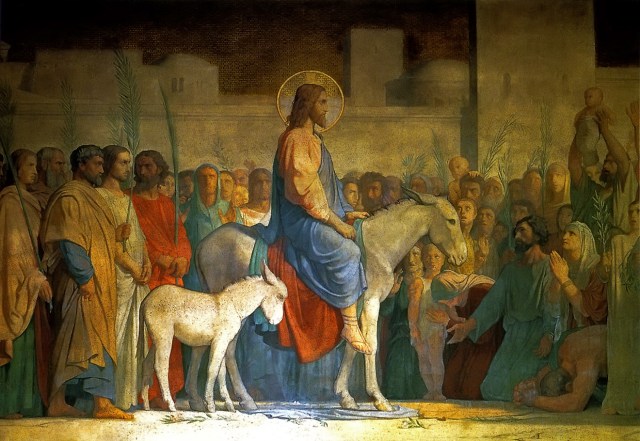
Our two gospel lessons this morning recount an entrance and an exit; Christ’s Triumphal Entry on Palm Sunday and His crucifixion on Good Friday.  The Church decided to start Holy Week with these two bookends, the good start where the people cried hosannas and the good exit where Jesus completed His work of saving sinners.

This good entrance and exit are put as close together as possible this morning to leave you with the lasting and memorable impression. The humble king entered and exited this world to give you a good start and a good finish!

Christ's Entry into Jerusalem by Hippolyte Flandrin c. 1842

This is the story of a king.  Christ enters a king and He exits a king.  He is the lowliest king the world has ever seen though.  Christ entered Jerusalem on Holy Week a humble king riding on a donkey.  No triumphant warhorse for Jesus, He chose to make His grand entrance on a beast of burden.  The people cried kingly words to Him, “Hosanna!  Blessed is he who comes in the name of the Lord, even the King of Israel.”

Christ exited Jerusalem on Holy Week as a humble king with crowds pleading for Him to be crucified.  No impressive throne or bejeweled crown for Jesus, He chose a cross for a throne and thorns for a crown.  The mocking soldiers used kingly words too, “Hail king of the Jews.”  A sign was placed over Him by Pilate as a charge against Him, “This is Jesus, the King of Jews.”

It’s easy for us to hear these accounts and identify ourselves with the “good guys” of the story.  We think ourselves as the crowds who greeted Jesus as the promised Davidic king with greetings of hosanna.  We reenact it every Palm Sunday with our palm branches and hosanna songs.  Certainly, we do so in true trust of our Lord Jesus.  We celebrate because we know the king’s procession on Holy Week was to the cross that would save us.  We need to consider how fickle this crowd was though and identify ourselves with that.  Who ran to Christ’s defense when He was tried?  Where were the cries and praises of hosanna then?  Some likely turned and added their voices to the shouts of “Crucify him!”

Every sinner can see himself in that fickle crowd.  With our tongues we bless and give thanks to God on Sunday.  With the same tongue we curse and complain on Monday.  One moment we are confident our humble king will answers our prayers.  The next moment we’re complaining or scared.  Like St. Paul we do not understand our own actions.  We often do not do the good we want to do while we often do the very thing we hate.  We sin.

During Holy Week we’re also called to identify ourselves with the religious rulers, the soldiers and with Pilate.  We like the Pharisees and Scribes are guilty of self-righteousness; quick to judge, slow to forgive.  We like the soldiers mock Christ’s suffering and death every time we sin and take for granted the cost of our salvation.  We are as unjust as Pilate when we allow injustice and wash our hands of guilt by thinking that our knowledge of the truth somehow forgives our apathy and lack of action.

We do not have a good entrance into this world.  We are born under sin and the condemnation of God’s Holy Commandments.  We were conceived with sinful flesh and have been God’s enemies from the start.  If we are wise we will confess this truth about ourselves; we are sinners.  Anyone who thinks he is wise is a fool, while all of the truly wise know they are fools. That is wisdom, but it is also true for saints. Anyone who thinks himself a saint is a sinner, and damned, while the saints know they are sinners.

If we do not repent we do not have a good exit ahead of us.  The Scriptures teach that the wage of sin is death.  The death you will die is because of the sin that clings to your very flesh.  Without forgiveness eternal death in hell is the inevitable end.  Even those who mocked Christ at His death would one day meet their own graves.  Death it seems is the ultimate equalizer.  Rich or poor, infamous or a nobody, when you meet death it pays no respect to your person.  It is the last enemy.

A comic I once read showed a man’s car parked in a grave as a voice chimed in, “You have reached your destination.”  Below the picture read “The Inevitable Navigation System.”  Death is the inevitable exit of us all if God had not sent us our humble king.

Our bad start and our inevitable bad exit is exactly why God gave us the humble king of Holy Week.  He was innocent where we were guilty of sin.  Even Pilate could find no wrong in Him, but the crowds pressed Him without evidence of wrongdoing.  Christ had lived the life without sin that we could not.  On the cross He received the wages of our sin by His death.  He was forsaken by God when we should be forsaken.  Finally, when He exited this world on Good Friday breathing His last, the earth quaked, the temple curtain tore in two, and a Roman soldier who might have mocked Him exclaimed, “Surely this was the Son of God.”  This humble king who entered lowly on a donkey and left humbled on a cross is God on earth sent to save you.

The blessed new of Holy Week is that by what the humble king suffered He has given you a good start where you had none.  Baptized into His death the wages of sin are paid, you are forgiven.  Just as He promised Christ has sent you the Holy Spirit that you might shout hosannas in true faith, trusting that Christ has answered your prayer to save you.  The king has given you a good start, but He also promises to bring it to completion, so He now sustains you again and again with His life giving, sin forgiving Word.  He feeds you His very body and blood in the Sacrament to strengthen your faith in Him.

Finally, the king has given you a good exit where you had none.  Just as God created the world in six days and rested on the seventh day, so for the six days of Holy Week Christ created your salvation and on the seventh day He rested in the tomb.  So, forgiven by Christ, when you exit this world your tomb is not your inevitable eternal location.  Instead a Christian death is a good finish, for the Christian knows and trusts the humble king who has entered death first and defeated it.  Your exit of this world, and all Christians before and after you, leads to a new entrance, the resurrection of your flesh to eternal life.  That is your inevitable destination dear Christian friends and it’s possible because the humble king entered and exited this world to give you a good start and a good finish!  In Jesus’ name, amen.

Posted in Lent, One Year Lectionary, Sermon | Leave a comment

Sermon: Lent 5 Midweek Galatians 3:23-29

Lenten Midweek Series

Rescued

A Six Week Meditation on the Sacrament of Holy Baptism

Thought for the Day from Bulletin Cover:

In Baptism we now put on Christ—Our shame is fully covered with all that He once sacrificed and freely for us suffered.  For here the flood of His own blood now makes us holy, right, and good before our heav’nly Father.  O Christian, firmly hold this gift and give God thanks forever!  It gives the power to uplift in all that you endeavor.  When nothing else revives your soul, your Baptism stands and make you whole and then death completes you.

All Christians Who Have Been Baptized, LSB 596

Sermon

[I am indebted to The Rev. Dr. Leopoldo Sanchez for some portions of this sermon.  Dr. Sanchez asked, “Who are you wearing?” to the delegates of the 65th Regular Convention of the Lutheran Church – Missouri Synod.]

The recent Oscar’s were much the same as the years before.  There is a liturgy to the Oscar’s and it begins on the red carpet where the rich and famous are asked, “Who are you wearing?”  It’s fashion-speak for which designer made the clothing.  “Laurent!” one will say.  “Prada!” another will say.  Most of us wouldn’t have an answer or if we did it would be something like “Kohl’s!” “Dillard’s!” or “Walmart!”.

Who you wear describes something about who you are.  Knowing your designers name because you actually have met them, and may be on a first name basis with them, reveals something about the circles you keep and sphere of influence you possess.  If I had a red carpet moment the interviewer would be unimpressed.  My lack of fashionable tags would reveal my humble state.

Yet, dear Christian friends, before we look past Hollywood’s question let’s consider the importance of their question.  For in a way they’re correct in wanting to know who you are wearing.  For who you wear says something about who you are.  So, who are you wearing today?

“For as many of you as were baptized into Christ have put on Christ.”  Who are you wearing?  “Christ!” says St. Paul.  This too reveals something about the circles you keep.  Baptized into Christ the Holy Spirit has made you a part of God’s family circle.  You are sons and daughters of God.  You are heirs to promises of God made long ago to Abraham.  Your ‘entourage’ transcends generations and centuries.  In Baptism you are made a child of God, Christ is your brother and all the saints behind and ahead of you are your siblings.

Your baptism also says something about the sphere of influence you possess.  When you pray your prayers are always answered.  You’re on a first name basis with God.  For the Father has revealed those who are in his Son will be heard.  Even when we don’t know what to pray the Holy Spirit is interceding for the God’s children on earth.  Even when you don’t get the answer you’re looking for, God has answered and answered well.

If you’re an heir to the promises of God, then that must mean there’s an inheritance.  You are promised the riches of God where moth and rust cannot destroy.  As Christ lives in the eternal blessedness and righteousness of God his Father, so also we will join Him and as adopted sons.  What the Son of God has is yours too.  As St. Paul said, “The sufferings of the present age are not worth comparing to the glory to be revealed.”  We have a beautiful inheritance given to us.  Want a glimpse?  Read the Scriptures of the glory of the risen Christ who is exalted into heaven.  Read the promises of Revelation 21-22 that speak of the glories of the new heavens and new earth that you will inherit.

You inherit all this and what did you do to get it?  Nothing!  You were baptized into Christ and so you have put on Christ.  This was not your doing.  This was God’s.  Don’t miss the passive voice that Paul uses when he talks about Baptism.  When you are baptized God is the giver and you are the recipient.  He richly poured out the forgiveness Christ won for you on the cross and he gives you the Holy Spirit that you may be strengthened and comforted daily in the one true faith.  On the cross Christ got your sin!  At baptism you received Christ’s death for sin!  On the cross Christ gave you his forgiveness!  At baptism you received Christ’s righteousness!  That’s what it means to put on Christ.  To trust that through baptism you’ve won all the benefits of Christ’s cross.

Now we see that if we’re ever asked who we’re wearing we have a magnificent and miraculous answer.  I wear Christ.  You wear Christ.  We wear Christ.

St. Paul was getting at an important point in the letter to the Galatians.  Since we all have been baptized into Christ regardless of our parentage, class, race, or sex, we are to look at one another differently too.  When we look at one another we should first see the other’s baptism into Christ.  Before making a single judgment about the other person’s character or status if they are Baptized then first we assume they are Christ’s.  If they are Christ’s then they are our sibling.

The waters of Baptism call us to look at one another with different eyes—the eyes of the Holy Spirit—even when we don’t understand one another, even when we don’t get along or disagree, our baptism calls us to see the Christ our brethren has received and put on.  It is through Baptism that we truly learn who we are before God and before one another.  At the foot of the cross and at the waters of baptism there is only level ground.  Not one of us stands higher then another.  Not one of us is more saved or received more grace than another.  Not one of us is more a sinner or less a sinner.  Not one of us is more a saint or less a saint.  We have all been clothed in Christ and his righteousness.

Our baptism is our first and highest calling.  We know that by baptism the old sinful Adam is gone and the new creature has arisen.  So in baptism we are called to treat one another accordingly; with love and forgiveness.  We are charged to encourage one another to do good for one another and our neighbor.  We are called to correct and call back the erring with patience and the tenderness of Christ.

Likewise there is one more implication to God’s Word for us today.  If baptism is for Jew and Gentile, slave and free, male and female, then that means baptism is for everyone.  It’s not just for those sitting in the pews with you today.  It’s for the gas station attendant down the road and the immigrant neighbor up the street.  “Look toward heaven, and number the stars, if you are able to number them.” God said to Abraham.  “So shall your offspring be.”  So shall your siblings be brothers and sisters in Christ Jesus.  Baptized into Christ we are called not to forget the promise and to share the promise that more and more people will put on Christ!  In Jesus’ name, amen.

SDG – Rev. Eric M. Estes

Posted in Lent, Sermon | Leave a comment

Sermon: Lent 4 Midweek Colossians 3:3-8a

Lenten Midweek Series

Rescued

A Six Week Meditation on the Sacrament of Holy Baptism

Thought for the Day from Bulletin Cover:

In Holy Baptism we have obtained the status of being children of God…[God the Father] will sustain, preserve, and provide for us.  He will never forsake us.  We have also received the righteousness of Jesus Christ.  All that Christ has obtained for us by his suffering and death has been given to us and made our own by Holy Baptism…He is the vine we are the branches.  Through Him we obtain new strength for every good work, light, wisdom, and grace.  There has been imparted to us the indwelling of the Holy Spirit!  He makes his home in us, sanctifies our hearts, governs our tongues and lips, and enables us to order our lives according to the Word and will of God.

Starck’s Prayer Book

Small Catechism Responsive Reading:

P:  What does such baptizing with water indicate?

C:  It indicates that the Old Adam in us should by daily contrition and repentance be drowned and die with all sins and evil desires, and that a new man should daily emerge and arise to live before God in righteousness and purity forever.

P:  Where is this written?

C:  St. Paul writes in Romans chapter six:  “We were therefore buried with Him through baptism into death in order that, just as Christ was raised from the dead through the glory of the Father, we too may walk in newness of life.” (Ro. 6:4)

Sermon

In the name of God the Father, the Son, and the Holy Spirit, amen!

            Early in my teen years I walked the aisle of a friend’s church to receive absolution after being crushed by the Law by the preacher.  He targeted my sin in the crosshairs of God’s Ten Commandments with the accuracy of an assassin.  I was feeling pretty guilty about some ill-advised adventures with my pellet gun.  Two of my friends who had joined me in the mischief were there, but they didn’t walk the aisle.  I later realized why.  When I got to front of the sanctuary I confessed my sin without implicating my two friends to the pastor.  What I received was an earful of how glad the pastor was that I was changing my life and how I was going to live a better life now that I had given my heart to Jesus.

I was confused.  Hadn’t I always been a Christian since my baptism?  I knew I had sinned grievously, but did that mean that I was never a Christian in the first place?  Was I not saved before this moment?  My friend’s pastor thought so.  He went on and on about how I was to live a better life now.  He told me that I wouldn’t aim my air rifle at the wrong targets anymore.  He kept saying that walking the aisle was my first act of obedience to Christ and now I was to live a life of obedience.

Certainly I wanted to live a better life, but wasn’t that the reason I first came up there?  In my mind I didn’t walk up there so I would change my life, but because I was powerless to do so.  I needed Christ to forgive me!  As a young Christian I had felt the struggle with sin.  Once I thought I had one sin whooped there would be another around the next corner.  When he was done talking I asked him if he was going to tell me I’m forgiven by Christ.  He looked at me funny and said just pray to God and ask Him to forgive you.

I left that moment with nothing to rest my conscience on.  I had no where to hang my hat and know that Christ had forgiven me.  I was left with the ‘ata’boy’ from the pastor for the “obedience” of walking the aisle and “committing” my life to Jesus.  I was left to the uncertainty of whether I would pray sincerely enough to be forgiven my sin.  In short, I was left to my works.

The Holy Spirit helped me through that dark day.  Since my conscience was still pricked and I knew something was amiss in that pastor’s counsel I went to my lifelong childhood pastor.  He had catechized me just a couple years before.  What I received was a Catechism refresher.  Every week my faithful pastor would direct me to the Word of Holy Absolution according to Christ’s command in John 20 for the assurance of my forgiveness.  Christ had died for all my sin, and yes, that included the last week’s iniquitous precision pellet pelting with my gun.  Likewise, my pastor encouraged me to the Lord’s Supper that I had been receiving now for about four years.  There Christ gave me the fruits of His cross as the Passover lamb that takes away the sin of the world.  My pastor pointed me away from uncertain things like my obedience and my weak prayers to the certainty of Christ’s salvation won for me and for you on the cross.

He didn’t stop there though.  He said, “Remember that you are baptized.”  He went on to remind me how I was born sinful, unrighteous, and an enemy of the Law and God himself.  At Baptism God drowned that old sinner in Christ’s death, all my sin had been placed on His cross, and then God raised me from the dead in Christ’s resurrection.  From that point on I am His new creature; forgiven and promised eternal life.  My pastor continued and said “Now remember what the Catechism says.  Baptism indicates that the Old Adam in us should by daily contrition and repentance be drowned and die with all sins and evil desires, and that a new man should daily emerge and arise to live before God in righteousness and purity forever.”  He told me how that was the struggle I was having.  The Old Adam still clings to my flesh.  Confessing my sin to my pastor was drowning that Old Adam and the only true way to live a God-pleasing life.  He said I was correct that I was powerless to change my life, but God in His great mercy had done everything I needed through His Son Jesus.  From that repentance springs forth a life of thanksgiving and good works said my pastor, but your repenting and your doing can never save you or change you.  Only our God can do that.

I share this long autobiographical story with you because my experience reflects much of what Paul was teaching in our lesson from Colossians today.  Baptized into Christ it’s your experience too.

St. Paul makes it clear that you can’t save yourselves.  He calls us foolish, disobedient, led astray, slaves to various passions and pleasures, passing our days in malice and envy, hated by others and hating one another.  That’s what all men are before they are baptized.  We are not just a little misguided and needing to change our life with the correct set of principles.  We don’t just need to recommit our lives to God.  We need to be chastened and killed, we need to freed and made alive again.  Elsewhere the Scriptures describe as spiritually blind, God’s enemies, and dead to God.  We’re as blind as Bartimeus when it comes to spiritual things.  Our hearts are just as much hateful enemies of God as was Herod’s.  We’re as dead as Lazarus was in the tomb.  Sinners don’t need reforming we need resurrection.

That is exactly what you received in Baptism.  After reminding where we came from, Paul now tells us who we are just like my pastor did when I came to him in my despair.

“But when the goodness and loving kindness of God our Savior appeared, he saved us, not because of works done by us in righteousness, but according to his own mercy, by the washing of regeneration and renewal of the Holy Spirit, whom he poured out on us richly through Jesus Christ our Savior, so that being justified by his grace we might become heirs according to the hope of eternal life.” 

Not our righteousness, not our works, not our obedience, (these things cannot save us), but the loving kindness of God who according to His mercy washed us in Baptism by the powerful working of the Holy Spirit.  He did this so we could be justified, that is made righteous.  By baptism we are spotless, clean, without the wrinkle or blemish of sin.  God did this by grace Paul said, that means we can not earn it.  We have nothing to boast of save for the forgiveness of our Lord Jesus Christ!

Reminding us where we came from through the waters of Holy Baptism Paul then encourages the faithful to good works.

“The saying is trustworthy, and I want you to insist on these things, so that those who have believed in God may be careful to devote themselves to good works.” 

It was sad to me when I realized that my friend’s church really was a case of getting the cart before the horse.  They encouraged good works at the loss of the gospel of forgiveness. I do not doubt that they loved Jesus.  Yet, they were so concerned with the problem of sin they turned the gospel into behavior modification instead of the proclamation of Christ’s forgiveness to broken sinners; even Christian broken sinners.

Our Catechism Responsary this evening reminds us that faithful Christianity does not make the opposite mistake.  Genuine Christianity does not encourage gospel forgiveness at the expense of good works.  The old Adam is daily drowned in us by Baptism that we might emerge to live before God in righteousness and purity forever.  We can see from Paul’s letter to the Colossians the gospel encourages us to good works.  He even wants all believers to “be careful” in devoting themselves to good works.  That means God intends for us to be intentional and thoughtful about what we do for our neighbor and God’s creation.  That meant I need to be intentional about what was in my sight when I shot my gun.  As I repented for my sin my pastor was not remiss in reminding me about my struggle with sin and encouraging me to live a God-pleasing life.  He reminded me that the Old Adam was gone, the new creation had come.  Even our repentance is a sign that God’s activity of regenerating and renewing us sinners is happening.  If God the Holy Spirit was not in work in us by our Baptism in Christ we wouldn’t repent.

So, dear brothers and sisters in Christ remember who you were once were (foolish, disobedient, led astray).  Remember who you are (washed, regenerated, renewed, forgiven).  Remember the trustworthy gift of Christ that you received in Baptism.  Remember that none of your salvation is done or earned by you but by Christ’s grace.  Together in thanksgiving this Lent we repent, let’s remember our baptism, and in thanksgiving be careful to devote ourselves to good works.  In Jesus’ name.  Amen.

SDG – Rev. Eric M. Estes

Posted in Lent, Sermon | Leave a comment

Sermon: Lent 4 John 6:1-15

In the Name of the Father, the Son, and the Holy Spirit, amen.

Looking at the five loaves and two small fish, Andrew shook his head and despairingly he said to Jesus “What are they for so many?”  Modern Americans like us would ask the same question.  The people of the land of opportunity would see no possibility in this young boy’s grocery bag.  The economists would come wringing their hands like Philip and say, “Not even 2/3rd of a living wage could buy enough for everyone to have a little.”  5,000 men and their families, about 15,000 people had followed Jesus without any provisions.  All we hear from the apostles is despair and lack of faith.  Can we blame them?  How often do we say there isn’t enough when we look at our budget?

The crowds were no better off.  They had followed Jesus, but later on they’ll desert him.  They’ll find out this Christ is not the kind of king they desire.  They would abandon his presence and the Word of God preached from his mouth and chase old and new idols.  You’d think multiplying bread and fish would be enough to convince them to listen, but fallen as we are humanity is a fickle bunch.  If our wants and desires are not met we will look elsewhere without even considering if our wants are really needed and our desires are really godly.

Yes, I am describing you and me too.  Our insatiable self-centered search for our desires has left us starving in numerous barren lands.  Credit card and other debts that accrued not because we didn’t have other options, but because we were certain some things are absolute needs when they really are not.  The desert of debt can be a lonely and overwhelming place that leaves one with an insatiable hole that no amount of money can seem to fill.  Then there’s the emptiness one loathes right after giving into their lusts by dehumanizing themselves and others by making their fellow creature just an object to fulfill their lustful desire.  It’s exciting for the moment, but leaves them emptier than before.  Likewise there’s the bitterness and prideful snobbery that come from passing judgment on others, refusing to forgive them or to overlook their minor faults or previous sins.  Such self-righteousness makes one feel superior and sadly fools one into thinking they’re spiritually full when they’re really emaciated.  Jesus called such people whitewashed tombs.  They looked clean on the outside, but inside were only dry bones with no life in them.  All these and many more things have left us in the bitter barren recesses of our souls—looking anywhere to satiate our hunger.  So much so our entertainment becomes not so entertaining anymore, our food is not as tasty as it had been, even our relationships are not as deep as they once were or should have been.  Indeed we are in America are entertaining ourselves to death; replacing God with celebrity gossip, food and drink, worry and debt, self-righteousness and pride, or whatever else we can find to distract ourselves.

When we look at what little of ourselves that we have left in these barren places we are forced to ask, “What are these among so many?”  Andrew’s despair becomes our own and we must look to the hand of the Lord who first asked, “Where are we to buy bread so these people can eat?”  His point is that there isn’t enough bread.  It’s not like you can walk to your local baker and say, “I’d like bread for 15,000 in the next hour.”  No, Jesus wanted the disciples and us to know there is definitely not enough bread.

Yet there’s this little boy, a child, who remembered to bring provision.  He makes an offering to God and lays his humble means at the Lord’s feet.  This miracle is an allegory for the church to learn from.  Jesus was using this opportunity to prepare the disciples for the ministry after his resurrection and ascension.  This boy is an example of the Christian.  The disciples are pastors.  The crowds are the entire church.  This boy brings his small offering and the Lord multiplies it to feed tens of thousands.  The point isn’t that if you give an offering you’ll receive it back ten-fold like the prosperity ministers say.  We aren’t even sure if they boy got any of the leftovers.  The point is that Christ, the Lord of creation, can take our meager offerings and bless them to the point of an overabundance.  Twelve baskets full were leftover.  There was more than enough bread and fish to share.

So, also us.  We bring our offerings to God and he uses them for his purposes to feed and nourish all people.  Certainly that includes very pragmatic and perceptible ways like when we care for someone in need out of our benevolence fund as a congregation or individually out in the world.  Also, though, our offerings gathered, even when meager, are multiplied in spiritual blessings for all those who encounter the Word and receive the Sacraments here.  Your offerings no matter how large or small ensure that others can hear the Word of Christ’s forgiveness, be baptized, and receive His body and blood at the Eucharist.

Indeed this gospel lesson is Eucharistic.  Who can’t hear of Jesus giving thanks, breaking it, and feeing thousands without thinking, “Hey, He did this again?”  The next time He’ll say, “This is my body given for you.”  He shares His body with the twelve and from thence to the thousands upon thousands.  Christ’s Word and blessing His body and His blood are given in abundance for all to be fed and nourished from the first generation to the last.

More important than teaching about our offerings this story illustrates the grace of God.  We cannot overemphasize the significance of the twelve baskets of bread leftover after everyone had their fill.  St. Paul wrote in Romans that were “sin increased grace abounded all the more.”  In Isaiah God said that Israel would receive a double portion of his mercy for their sin.  Christ is not a stingy giver.  I always thought the lyric from the hymn Guide Me, O Thou Great Redeemer that reads, “Feed me until I want no more.” strange.  Can we ever get enough of God’s grace?  In one sense, no, but in another yes.  In one sense we can’t get enough because we daily sin much.  In another sense yes God can fill us until we need more.  The loaves and fish teach us that.  God pours on so much of His forgiveness in Jesus Christ that there is more than enough to cover all your sins.  You don’t have to worry about whether or not God can forgive you for your sin.  No matter how recent or how ungodly your sin Christ has provided abundantly for your forgiveness.  God is not a miser with any of His gifts and especially this is true for the forgiveness won for you on Calvary’s cross.

Let us not take for granted how the Lord has given abundantly all we need for this body and life, but also what we need for our souls.  As it stands we have the right to free assembly to hear the Word of Christ, to receive absolution, and eat his supper.  You can get his Word in the book store right next to us or the Walmart down the street much less almost any hotel room on the continent.  We are blessed to have many Christ centered churches that proclaim that we are saved by God’s grace alone, not by works, but by Christ’s death for our sin.  Let us not neglect the spiritual food that he has given us to eat.  Read, mark, inwardly digest it, for there might be a day when it is not so readily available and what will you do then when it is scarce?

Yes, beloved, the Lord has provided us with an overabundance of his holy food so that we might be filled.  As we receive His forgiveness won for us on the cross we know that what he said to the Evil One is true, “Man does not live by bread alone, but from every Word from the living God.”  When we know as Peter would confess in this same chapter of John, that Christ has the Word that leads to eternal life all those other wastelands we have run to are overcome.  We know that the things that prick us and the pangs of hunger that trouble us because of our sin or the brokenness of this world are only temporary.  Christ has overcome them all and even now he feeds us to strengthen us in the midst of them.  In Jesus’ name.  Amen.

Posted in Lent, One Year Lectionary, Sermon | Leave a comment

Sermon: Lent 3 Midweek 1 Peter 3:18-22

Lenten Midweek Series

Rescued

A Six Week Meditation on the Sacrament of Holy Baptism

Thought for the Day from Bulletin Cover:

Do you live where Christ is? Do you live where God has his delight? Yes, because God has put his words on you too. With the water His name was put on you at your Baptism. You are not just a doubtful, ambiguous, meaningless, hopeless bunch of atoms bouncing around. You have the Word of God put on you. At your Baptism, most certainly, and at Jesus’ baptism too. There Jesus is in solidarity with you and you with him. Because he is the beloved Son, you with him are beloved sons and daughters. You are delighted in and beloved by God.

Rev. Norman Nagel, Sermon for Baptism of our Lord

Small Catechism Responsive Reading:

P:  How can water do such great things?

C:  Certainly not just water, but the word of God in and with the water does these things, along with the faith which trusts this word of God in the water.  For without God’s word the water is plain water and no Baptism.  But with the word of God it is a Baptism, that is, a lifegiving water, rich in grace, and a washing of the new birth in the Holy Spirit, as St. Paul says in Titus, chapter three:  “He saved us through the washing of rebirth and renewal by the Holy Spirit, whom He poured out on us generously through Jesus Christ our Savior, so that, having been justified by His grace, we might become heir having the hope of eternal life.  This is a trustworthy saying.”  (Titus 3:5-8)

Sermon

This evening’s sermon was preached by Chaplain Rev. Graham Glover USARMY CPT.  Rev. Glover is a member of Lutheran Church of the Redeemer and serves the soldiers of Fort Benning, GA.  Please click the player below to listen to this message on 1 Peter 3:18-22.

Posted in Lent, Sermon | Leave a comment

Sermon: Lent 3 Luke 11:14-28

This Sunday’s sermon was preached by Rev. Charles Ferry.  Pastor Ferry and his wife Cheryl have been called to serve as representatives of the Lutheran Church – Missouri Synod in Southeast Asia.  Please click here to learn more about the Ferry family and the good work they intend to do in serving the Church and world.  Please also consider supporting them with your prayers and financial gifts as you are able.

“[Jesus said:] But if it is by the finger of God that I cast out demons, then the kingdom of God has come upon you.” – Luke 11:20

Dear brothers and sisters in Christ,

If you haven’t noticed, things are different.  Today, of course, you have someone different standing in your church’s pulpit.  It’s a great privilege for me to be here with you today, to share not only what your church is doing overseas in Indonesia, but to be sharing God’s Word with you, and partaking with you in His holy Sacrament.

But it’s more than just a different preacher speaking to you.  There’s purple on the altar and in the chancel.  We’re refraining from using certain words, and from singing certain hymns and canticles in the liturgy.  Some of you have given up certain things that you enjoy, or added some practices that you normally don’t do.  This is the holy season of Lent, which only lasts a few weeks each year, but which makes some sweeping changes in our life together as Christians.

In Lent, we deprive ourselves of things in order to practice, in order to sharpen our focus on the cross of Our Lord Jesus Christ.  We meet during the middle of the week to hear the Word and to pray.  Lent is just a different time of year, a bit more somber, perhaps, where we hear a lot about sin, about repentance, and even about blood.

Even the Lectionary brings us these changes, reflects this holy time of the year, one that’s set apart for a specific purpose.  Not only this week, but for all these three Sundays in Lent, the Historic Lectionary of Christendom has brought us readings that feature Satan and his demons.  Did you notice that?  In Lent I, Jesus was driven out into the wilderness, where He fasts for 40 days, and then is tempted by none other than Satan himself.  In Lent II, we had the Caananite woman who was begging Jesus for help… because her daughter was “severely oppressed by a demon.”  And now, in this Third Sunday in Lent, we have Jesus being accused of being in league with “Beelzebul, the prince of demons,” and Jesus Himself is casting out demons and is accused of being in league with the devil.

This, my friends, is not comfortable for us.  It’s certainly not comfortable for me as the preacher.  As a visiting pastor, I’d love to come in here and preach to you nothing but sweetness and light, especially to people who have been kind enough to offer us support and friendship.  But this is the text I’ve been given… and it made me wonder if your pastor had something against me!  But no, Pastor Estes and I have known each other for many years now, and I know him better than that.  He’s simply a faithful under-shepherd, keeping us focused on what the church has handed down through the ages, and not letting us meditate on whatever tickles my fancy this particular day.

And that’s good… because if we didn’t have blessings like the lectionary, we most likely would not stop on a text like this, nor like the ones we’ve been hearing these days of Lent.  We don’t like to talk about Satan.  We like to dress him up in a red costume with tail and pitchfork, and make a laughing stock of him.  We like to put him in cartoons and movies where we can see him and ultimately control him.  And you know what?  That’s fine with him.  He doesn’t mind at all as we make him look funny or harmless or even fascinating.  That way, we don’t guard against him.  We give him lots of credit for being powerful, but he’s largely ignored, put in the background.

But in these purple days of Lent, the historic Christian Church simply won’t let us do that.  In these days, the church brings Satan out front and center so we don’t forget him, so we have to take notice of him.  And while that’s not comfortable, it’s good for us.

Satan is powerful, as we see throughout the Scriptures.  He’s constantly leading people astray, causing problems, and wreaking havoc wherever he can.  Even in our text today, Jesus Himself describes Satan as “the strong man.”  But to see he’s powerful, we really only need to look in the mirror and be honest with ourselves for a bit.  And when we do, we realize that Satan’s only real power is to lie, and we’ve swallowed his lies: hook, line, and sinker.

As a human being in this world, you believed him when he told you that your sins really aren’t that bad.  “Go ahead and hold that grudge,” he says, “it’s not like you killed anyone.”  “Go ahead and indulge that lustful image, it’s not like you’re committing adultery in your heart.”  “Go ahead and believe in whatever god you want, if God is love, then love is god, and all roads must lead to heaven.”  “Go ahead and skip church,” he drones on in the sweetest tones, “you do enough good things already… and you’re not nearly as bad as your neighbor, so you’re doing alright on your own… what do you really need Jesus’ forgiveness for anyway?”

Ever since the Garden of Eden, all those thousands of years ago, Satan has been lying to us, speaking words that make us question the Word of God, tempting us to put ourselves in the top spot.  “Did God really say…” And we bite every single time.  As descendants of Adam and Eve, we share in the pride of our first parents, and as we say in our baptismal liturgy, we are “all conceived and born sinful, and so are under the power of the devil,” and any parents here can testify to just how self-centered we are even at the youngest of ages.  Satan, as our Lord Jesus describes in our text today, is the strong man, stronger than you, who has come fully armed, and made your heart his palace.  There, his goods would be forever safe while we build ourselves up in vain.

But something has changed, something is different, as we’re reminded in this time of purple and repentance.  The strong man was very secure in his palace, counting his treasures and plotting how to get more.  And before he even realizes what has happened, before he can even hope to mount a defense, Satan the strong has been disarmed, stripped of his armor, and robbed of all his ill-gotten gains.  One who is infinitely stronger than Satan has come in the most unexpected of means, utterly defeated him, defanged the serpent, and deprived him of everything he had.

Jesus Christ, my dear brothers and sisters, had laid aside His rightful crown for a time and come not in glory and power, but in meekness and humility.  He came in human flesh and blood, was born in a lowly stable, and grew up subject to his earthly parents.  Then He went to the cross of Calvary, suffered, bled, and died like a common criminal, taking upon Himself all the price that your sin demanded.

When He hung upon that cross, crying out in pain and thirst, it looked as if he had been defeated by the strong man.  But that apparent defeat turned out to be the greatest and most unexpected victory the world had ever seen, or would ever see.  Jesus turned that death on the cross into YOUR victory, where all your sin was covered, all your debt paid, and His righteousness became yours.

In His death on the cross, Jesus made Himself your champion, setting you free from bondage to sin, death, and the devil himself.  Jesus is the Stronger One who comes in and attacks all your old evil foes, defeats them, and grants you freedom and life so you can belong to Christ instead.  You, my friends, are not only the battle ground, but you are the spoil; you are the treasure.  Christ Jesus has not left you alone to fight or to surrender, but has come to earth and given Himself in your place, so that His forgiveness, life, and salvation would be yours forever.  When those baptismal waters washed over you, Christ was uniting Himself to you with bonds that cannot be broken.  He was setting you free from the lies of the devil, and setting up shop in the now cleaned-out house that is your heart.

You no longer belong to darkness, as St. Paul talks about in our Epistle reading today.  Now, because of Christ, you are light in the Lord.  You are no longer enslaved to the thoughts, words, and actions that are out of place with the saints of God.  By His Holy Spirit, He empowers you to live a life that is different from that of the world around you, with different priorities, different values, and different goals.  You no longer have to live a life that puts yourself first.  God has already given you eternity in paradise with Him… now you’re free to live your earthly days in service to others, as lights in the darkness.

And to help you do that, He calls you to His holy altar again this very day, where He has set a banquet table before us, inviting us to partake in His very body and blood, given and shed for the forgiveness of your sins, and to build us into a community, into members of His body the Church, with Himself as our head.  With this meal, He strengthens you for the road ahead, uniting you once again with Himself, and with one another, creating and maintaining your faith in Him so that nothing can separate you from Him.

Christ calls you to Himself, casts out the demons that would lie to you and keep you captive, and says that the kingdom of God has come upon you!  The Stronger One has set you free, and you belong to Him forever.

In the Name of Jesus, Amen.

Posted in Lent, One Year Lectionary, Sermon | Leave a comment

Book Review: ‘The Lifelines of Love’ by Rev. Dr. Peter Kurowski

This book review was originally written by Rev. Eric Estes for our congregations’ newsletter ‘The Seed of Life’ under the section entitled, ‘From Pastor’s Bookshelf’.

lifelinesSearching through the shelves of marriage books can be quite daunting and sometimes quite frustrating.  It is daunting because there are quite frankly too many.  It is frustrating because all of them claim the same thing, “This book will help/save/improve/enliven/heat-up your marriage!”  So many books make so many of the same promises and all of them claim they have discovered the steps toward marital happiness.

Firstly, there are many helpful books out there that I have read.  I have enjoyed them, used them personally for my marriage, as well as for pre-marital and marital counseling.  There’s a lot of wisdom to be shared on the subject of marriage and one book really can not cover it all.  There are books for communication, for rearing children, for dealing with family boundaries, and for finances to name a few subjects.  There are also books for marriages affected by sorrow like the loss of a child or pain like the trials of alcoholism.  If your marriage is faltering or fumbling because of some challenging circumstance then publishers can almost guarantee there are books on the subject and many of them are very wise and very helpful.

The difficulty for me as a pastor has not been finding books that help with particular needs of marriage or particular problems, but instead I have struggled to find a good primer on what marriage is.  Sure there are plenty of books about marriage in general and they give a lot of practical advice and to-do lists to help one’s marriage, but their deepest flaw is that they provide no foundation and framework from which to live out the entirety of one’s marriage.

The assumption is that if a couple loves one another and follows the “steps” in a book then their marriage is complete.  Sadly, many marriages have been shipwrecked on this kind of legalism.  I’ve spoken to couples who have followed all the rules and kept all the guidelines, but still they struggle with their individual frustrations and disappointments.  They often heap on more to-do’s to their list in the hope that it might fix their marriage.  Yet, more times than not they are unsuccessful.  They are often missing the larger picture of marriage as a God-created, God-ordained, and God-blessed estate which is as much a part of the fabric of the creation as the air we breathe and the food we eat.

Providing a framework and foundation on which to build your marriage is exactly what Peter Kurowski has done in The Lifelines of Love.  I think my search for a primer book on marriage has finally come to an end.  This book is a spectacular pearl among many rivals.  No other books that I have read about marriage are as faithful to the Scriptures and Christ-centered as Lifelines.  This book provides a Biblical foundation for marriage in accessible prose that will help Christian couples found their marriage-house on the rock which is Christ instead of so many other sinking-sand-legalisms offered by the world.

What are the ‘Lifelines of Love’?  In short the lifelines are what Lutherans call the Means of Grace—God’s Holy Word and Sacraments.  In this book Pastor Kurowski has applied God’s Law and Gospel to the gift of Holy Matrimony.  By God’s Word he calls all couples to humility and repentance in the forgiveness of their sins.  How much marital strife would be avoided if we only would learn humility and repentance?  Kurowski gives us a good idea of how much in the chapter on forgiveness.  As you read Pastor Kurowski dives into many practical and necessary topics for a healthy marriage such as Forgiveness, Faith, Fidelity, Freedom (to serve one another), Finances, and Family.  While this book is full of practical advice to apply to your marriage Kurowski will again and again teach how repentance and forgiveness in the comfort of the Means of Grace is the primary necessity in a healthy marriage.

The chapters on forgiveness and faith make this book well worth its cover price, but every chapter is loaded with helpful wisdom, practical insight, and rich forgiveness from the gospel of Jesus.  This book doesn’t only teach about marriage, but about the chief doctrine of the faith—the forgiveness of sins received by faith in the Savior Jesus.  He even explains the doctrine of the Trinity and how it informs our marriage.  In the Trinity we see God in relationship as three persons.  The Father, Son, and Holy Spirit love one another and therefore it can be said as St. John did, “God is love.”  Kurowski touches on many important Christian doctrines with a distinctive Lutheran perspective and their application to Christian marriage.  I really would not have guessed that a marriage book could teach the faith so well, but Dr. Kurowski has pulled it off and in a readable and entertaining package at that!  I highly recommend anyone purchase this book whether they are single, engaged, or have been married for decades.  You will be blessed by what it has to teach for most of all it delivers to you the grace of our Lord as we give thanks to God for the gift of marriage and of His Son our Savior.

The Lifelines of Love by Peter Kurowski is currently available at Amazon.com.  14.85 USD.

Kurowski, Peter. The Lifelines of Love. City: Gardners Books, 2007. Print.

Posted in Books, Newsletters | Leave a comment

Sermon: Lent 2 Midweek Colossians 2:6-15

Lenten Midweek Series

Rescued

A Six Week Meditation on the Sacrament of Holy Baptism

Thought for the Day from Bulletin Cover:
            How great is Your goodness that You found the one who was not even seeking You.  You listened to the one who was not yet praying.  You opened the door to the one who was not yet knocking.  Your mercy is far greater than any praise I could render.  Your mercy is beyond my comprehension.  I was baptized in Your holy name.  Your name was invoked o me.  I was received into the heavenly family and made a child of the heavenly Father; Christ became my brother.  I became a temple of the Holy Spirit…I was washed clean and purified of all my impurities…I give to you, my God, eternal thanks for this immeasurable kindness.

Johann Gerhard, Meditations On Divine Mercy

Small Catechism Responsive Reading:

P:  What benefits does Baptism give?
C:  It works forgiveness of sins, rescues from death and the devil, and gives eternal salvation to all who believe, as the words and promises of God declare.
P:  Which are these words and promises of God?
C:  Christ our Lord says in the last chapter of Mark:  “Whoever believes and is baptized will be saved, but whoever does not believe will be condemned.”  (Mk. 16:16)

Sermon

In the Name of the Father, the Son, and the Holy Spirit, amen.

It happens that often a witness to a major crime must be protected.   It’s the stuff of thriller movie plots.  Evil forces are bent on killing the witness who would incriminate them in court.  It’s also sadly the stuff of real life.  Thus, safe-houses, are created by law enforcement for the protection of the witness and the goal of convicting the guilty.  Unfortunately, a safe-house may not turn out to be so safe.  The location is compromised and the witness is in grave danger.  So, the need is always to outwit evil and to perhaps find another safe-house.

You dear Christians have a bounty on your head.  Paul warns today that there are forces that want to take you captive by philosophy and empty deceit according to human traditions, elemental spirits of the world, and not according to Christ.  The list of villains gunning for you is long.  Philosophy and the deceit of human traditions can be quite tricky.  We might think that philosophy is only practiced by the upper echelons of society and ivory tower academics, but that is untrue.  Everyone from your local newscaster to Oprah Winfrey or the latest sitcom is underpinned by a certain philosophy, a certain worldview, and certain traditions of man that are not according to Christ.  The Christian must practice discernment before he is swept away by the competing empty and false philosophies espoused by their fellowman.  That’s not even mentioning that the Scriptures recognize we are engaged in conflict with spiritual realities, elemental spirits as Paul says, that would like none other than to eradicate the name of Jesus and His witnesses.

However, brothers and sisters, where you have been filled in Christ, there is the safest house.  Paul points you to God’s safe-house where you have been filled and rooted in Christ and he starts right here at the baptismal font.  Paul says that the miracle of Baptism has set you solidly on the foundation of Christ.  You were “buried with Him in baptism.”  As Christ was rooted in the ground, in the tomb, so you are rooted, solidly grounded, with Him in your baptism.  By your baptism Paul says “you have been filled in Him…” equipped with every spiritual blessing from the heavenly realms; ready and kept as His for eternal life.  You were also raised with Him, in baptism, to live each day in the promise of the resurrection and in the certainty that the powerful working of God that raise Jesus from the dead is at work in you at this very moment.

That’s just the cusp, the tip of the iceberg, my brothers and sister, for Paul says that Baptism has filled and rooted you in all the saving work of Jesus Christ.  By your baptism you share in everything we remember and meditate on during Lent.  His passion and suffering become yours as you walk with Him to certain death. On Christ’s cross, He crucified you with Himself, insuring that your old-Adam, your sinful nature, would be slain.  He gives this to you, Paul says, in baptism.

He who died for you is the one who is God, for “in Him the whole fullness of the deity dwells bodily.”  The true and almighty God interpenetrated with the body of Christ was the effective sacrifice for your sin.  The fullness of God bled for you!  You have been baptized into all of Him, His work and His person—human and divine—given for you for the forgiveness of your sins.

He did this so you can rest your conscience on this fact.  God does not deal with you according to your sins, nor requite you according to your iniquities.  Though your old self may yet deceive you into thinking that God is punishing you for all your trespasses that old-Adam cannot condemn you.  Your “body of death” and the “uncircumcision of your flesh” have been put off and buried with Christ for good by your baptism.

Isn’t that a comforting message that Paul has for us?  Buried with Christ in baptism, your sin is entombed forever.  Raised in Christ by in baptism, all the demands that damn you and haunt you have been satisfied.  Nothing has any claim on your, but Christ your Savior who has brought you to live safely in His house forever.

Therefore you are in the safest house as you are in Christ.  You need that house, because as I said before danger lurks as you walk through this vale of deceit.  Because you were once “dead in your trespasses and the uncircumcision of your flesh”, your old-Adam would love for you to have a reunion with the old-neighborhood.  He would like to move back into the old house of sin and deceit that Christ had purchased and redeemed you from.

Since you often fall in weakness to temptation to evil thoughts and desires you might begin to think there’s some rot in your root and perhaps your foundation is beginning to crack.  “Maybe I don’t stand firm in Christ after all?”  “Am I devoid of my Lord since I still sin?”

Not only that, but along with the Colossians, you are assaulted by all kinds of philosophies and worldviews that tell you there is better way than depending on Christ.  Some tell you to surrender and give up the fight.  They tell you that sin is only natural and you should not resist your lusts and inclinations towards unloving actions.  Others tell you how life can be better if you only do things yourself.  That was not much different from the heresy that afflicted the Colossians who were being tempted towards a religion that claimed higher more “spiritual” experiences if you followed the right pattern and instructions of the false teachers.  If the powers that exist cannot completely eradicate Christ from your life than they’ll just try to add something.  Jesus plus whatever will make you think you’re more spiritual and more worthy of God’s grace.  When we think on these things it can make us question how safe we are in God’s house.

But listen!  Your house is safe!  “The cosmic powers over this present darkness” cannot harm you, since Jesus nailed your salvation shut saying “It is finished.”  When one of God’s Called and ordained servants proclaims you forgiven, be assured that no one can escape this forgiveness.  The very forgiveness you have in baptism is the same forgiveness which is preached into your ear—real forgiveness here and now by the power of God’s Word—the same Word that was powerfully at work in your baptism into Christ.  You see this wall?  I know that the foundation was made strong for this building.  It has stood for decades.  I trust it enough that I’ll lean on it.  Though its possible to collapse any structure you have a house that is more certain that any building made by hands.  Your safety is promised and rooted on the foundation of God who is Christ—the risen and reigning savior of the world.  You can lean your entire person-mind, body, and soul-on this truth!

So now you can face the danger that lurks to capture you in confidence knowing that Lord in baptism has rooted you to Himself.  The very godhead has united Himself to you.  You walk in safe because as St. Paul says nothing can separate us from the love of God in Christ Jesus.  Nothing in life and not even death can keep you from God because He has promised to keep you safe.  This same Lord Jesus goes with you now as He has made You one with Him, so you can pray to Him for strength against your enemies as He taught you to say, “deliver us from evil.”  Likewise He has given you His Word and Absolution to guide and protect you from the assaults of the empty deceit of man and the Evil One alike.

By your baptism you are in the safest house. Rooted and filled in Christ you live forever; you have peace, joy, and pleasure; you become clean, righteous, and powerful against the devil and death, “and nothing shall hurt you” (Lk 10:19). You are safe in Christ, now and forever.  Amen.


Posted in Lent, Sermon | Leave a comment