
Bible Study: “A Man Named Martin”
Upcoming Adult Bible Study
“A Man Named Martin” – Part 1: The Man
Starting Reformation Sunday October 25th @ 9:00 A.M.
 From Lutheran Hour Ministries: In A Man Named Martin viewers encounter a 15th-century religious reformer from Germany who broke ranks with the Catholic Church. This Bible study is the first of a three-part series devoted to Martin Luther — a monk whose Spirit-inspired grasp of God’s justification of sinners through faith in the Savior was the cornerstone of the Protestant Reformation.

In this five-session Bible study, Luther’s life and times are examined through the lens of history, religion and theology. Expanding on commentary from Rev. Gregory Seltz, Speaker for The Lutheran Hour, numerous scholars add their expertise and perspective to render an illuminating portrait of the life of this extraordinary human being.
The influence and impact of Luther’s life is the stuff of serious study. As a forlorn sinner feeling lost and desperate before a stern and exacting Judge, Luther desponded of all hope for eternity. But as one who came to cling to the Spirit-delivered truths of justification by faith and the liberty believers experience by God’s grace, he rebounded to become a triumphant ambassador for the Gospel.
The details of Luther’s life—his childhood with his parents Hans and Margaret, his university pursuits, his decision to become a monk, his protestation of Catholic practices, his voluminous and erudite scholastic output, his life in hiding, and his roles as husband and father—are all considered in this study. A Man Named Martin is a fresh and explorative look at an individual who, down through the centuries, has increased in importance and vitality to the Christian church.
To this day, Luther’s staunch faith and the extent of his outreach, remain a standard for Christ-centered living to believers in the 21st-century.
Posted in Uncategorized
Leave a comment
Sermon: Trinity 18 – Matthew 22:34-46
Trinity 18
Matthew 22:34-46
“Tangible Love”
When Facebook and other social media were first becoming popular it wasn’t too uncommon for someone to fill in the religion section of their profile with the word “love.” If you asked some of them what they meant like I did the answers boiled down to this. “God is love, so we should love.”
It sounds so simple doesn’t it? How can someone disagree with that? There are certainly Bible passages that would read similarly. How can you knock someone for wanting to be a good person or trying their best to love their neighbor? Their desire to be a good human being is certainly laudable, especially if by being “good”, they mean following the 10 Commandments.
The troublesome thing with saying your religion is just “love” is that it is an abstraction. Even saying “God is love” is abstract if you don’t qualify it with how you know God is love. When I asked my friends how they know God is love the responses were similar: “I don’t know. He just is.” Or “Well, I’m able to love, so it must have come from him.” Can you see how love in the abstract isn’t really that comforting? When love is just some generalization, an emotion, a feeling, or something that “just is”, how is it supposed to comfort when we have abused our neighbor, cheated our boss, or lost our child, spouse, or friend, or face our own death? Abstract love in those times can taste as saccharine as those chalky little valentine hearts with “be mine” printed on them. Love in the abstract can’t comfort, can’t help, can’t protect, and can’t save.
Imagine a husband who writes his wife beautiful poems and speaks eloquently of his love, but refuses to pick up the kids from school, or walk the dog, or hold her when she cries, or always seems to have a business trip planned when they’re supposed to visit her parents. She won’t care about his love in the abstract. It’s useless.
The Pharisees in our gospel lesson came to Jesus with a question. It was one of their favorite exercises. Let’s talk about the greatest commandment. They’d sit about and speak eloquently of why one may be more important than another. Even more they would imply with their philosophizing and pontifications that they kept this commandment—it made them feel like holy people. Most of all it was safe. They could keep the conversation in the world of abstractions—all talk, no bite, the commandments as an exercise in the abstract. They invite Jesus to join their game.
I’ll put it simply. Jesus does not play the game nicely. He doesn’t let them think that their religious abstraction game is good enough. He does not throw around clichés like we can when we say words like “God” and “love.” In fact Jesus goes straight for the jugular of the Pharisees, this is a kill shot, he damns them with their own question in a just a few short words. They want to know which is the greatest Commandment, but Jesus won’t pick one, two, or three—he picks them all. He summarizes the first three commandments by saying: ““You shall love the Lord your God with all your heart and with all your soul and with all your mind” And then he summarize the rest when he says: “And a second is like it, You shall love your neighbor as yourself. On these two commandments hang all the Law and the Prophets.”
If you think good people will go to heaven than this kind of preaching from Jesus is going to disappoint you. It’s not the kind of preaching our itchy ears hope for. It doesn’t dazzle. It doesn’t make for popular television preaching. It delivers the whole Law. You must be undivided and love God above everything else. That means you know God not as an abstraction, but as a person. That means you listen to his voice at all times and never once transgress what he commands. You must not be distracted in heart and mind. And the first commandment informs the second. If you love God than you also will love your neighbor perfectly, with equal devotion. You will never let a friend down. You will keep every promise. You won’t skip class in disobedience to your teachers. You will never tell a white lie to your boss to gain their favor. You won’t speak a harsh word or ever talk about someone else when it is out of turn.
Perfect love toward God and toward your neighbor is what’s required. If even a portion of your heart, soul, or mind is withheld from the Lord, you don’t love Him. If you felt slighted when a friend did not help you, but avoided eye contact and withheld compassion from that stranger then you have not loved God and you have not loved your neighbor as yourself. If there is even one thing you would do for yourself but not for your neighbor, or have done for yourself but denied to your neighbor, you love neither neighbor nor Lord. Repent.
Jesus would not allow the Commandments to remain in the abstract. He gave them teeth and when sinners encounter them we are bitten. Yet, we can be thankful that Jesus does not leave matters there. He has compassion on the Pharisees and on us. And this compassion is not abstract, it is real, and it is tangible.
The overall well done English Standard Version translation does a disservice in our reading this morning. When Jesus concludes explaining the greatest commandment he does not exactly say, “On these two commandments depend all the Law and the Prophets.” He actually says, “On these two commandments hang all the Law and the Prophets.” He’s using a Hebraism, the word “hang”, is reference to the hanging of a dead body defeated in battle. It’s the same word the New Testament uses for crucify. On these two commandments hang all the Law and the Prophets.
He’s giving them and us a hint about his question that follows. He asks about the Messiah. They all knew the Christ would be David’s Son, but how can David also call this Anointed One, Lord? The Psalm actually says “Yahweh” by the way, that is David calls the Messiah the divine name of God. Jesus is being their teacher now and lovingly showing them that the Messiah to come is both David’s Son, true man, and David’s Lord, true God. This in fact is the Messiah to whom all the Law and the Prophets testify would come to save the people from all their enemies. God would come not in the abstract, but with skin on—God in Christ Jesus.
On these two commandment hang all the Law and the Prophets. Christ is telling us why he came into the world. He came to hang. To be crucified for those who are condemned by the commandments. To fulfill them by loving God, not in the abstract, but with his very life. To fulfill them by loving his neighbor, not as an abstraction, but hanging on two pieces of wood and between two criminals. He did not come down as a heavenly platitude singing “roses are red, violets are blue…” Rather he came as love incarnate—love that would bleed for you—love that can actually save you from what you deserve. He is your substitute. He is the husband that love in word and deed. He lays down his life—he hangs to suffer your fall. He forgives you and he delivers this forgiveness to you in real and tangible ways now. The word of forgiveness preached into your ears. The Baptism applied to you. In his real bodily presence at the table of the Holy Communion given and shed for you for the forgiveness of sins.

Christianity is the religion of love. It does not speak in eloquent clichés though. God’s Word teaches, “In this is love, not that we have loved God but that he loved us and sent his Son to be the propitiation for ours sins.” (1 Joh. 4:10). Love is found in God before it is ever found anywhere else, for “God is love.” (4:8). When we know the love of God in Christ who laid his life down for us (3:16) then, and only then, can we talk about our love: “Beloved, if God so loved us, we also ought to love one another.” (4:16). It is important to remember that Jesus’ love is not just an example to follow, but the greatest love possible, the love which saves us from sin and death (Rom. 5:8). This distinguishes Christianity from any other religion that claims the virtue of love. The Christian religion is about God’s love first and the giving of that love through the cross of Christ.
As we receive this love from Jesus by faith the same love becomes a power in our lives. He who believes is “Born of God and knows God.” (1 Joh.4:7). When our hearts are opened to the love of God by faith in Jesus we are overwhelmed and captured by it. Not so fully that we cease to be sinners that need forgiveness, but so that we can honestly say with St. Peter, “Lord, you know everything; you know that I love you.” (Joh. 21:17).
In + Jesus’ name, amen.
Rev. Eric M. Estes
Posted in Uncategorized
2 Comments
Sermon: Trinity 1- Luke 16:19-31 – “What does the Bible say about being lost?”
Trinity 1
Luke 16:19-31
This morning we consider the question of what the Bible says about being lost. Our guide will be Jesus’ Parable of the Rich Man and Lazarus, our gospel text. If it were in his power the rich man would have you feel sorry for him. He sees his own lot, now in hell after enjoying good things on earth, and he wants pity; pity from Abraham and pity from Lazarus.
He’d almost have us fooled into thinking it was unjust for him to now suffer the pangs of his torment in hell. Except his behavior in hell is little different than it was on earth. He only thinks of himself and those like him (his brother). He still treats Lazarus like a servant trying to order him and Abraham to cool his tongue. He doesn’t ask to leave hell, so he doesn’t want to be with God in heaven. On top of it all he strongly insinuates that God hadn’t warned him well enough about the destruction he brought upon himself when he asks to send a resurrected Lazarus to his brothers. By this request he insinuates that the Word of God in the Law and the Prophets wasn’t enough, that God wasn’t clear, and if he had only had a miracle or two in his life then he would have repented of his sins.
Something to consider is that during his earthly life a rich Jewish man like him would not have been an atheist. In fact he may have considered himself quite holy. To him his riches and possessions were evidence that he was a good man while Lazarus’ poverty proved that Lazarus was a sinner. He believed in the God of the Bible, yet he was still lost to God.
This parable carries a difficult warning: you can believe in God and still be lost. The rich man believed, but he built his life on everything except God. Kirkegaard wrote that sin is building your identity on anything, but God. Luther put it this way in the Large Catechism, “A god means that from which we are to expect all good and in which we are to take refuge in all distress. So, to have a God is nothing other than trusting and believing him with the heart.” The rich man had a god, status and wealth. Now that he is dead that status and wealth were gone. He couldn’t take them with him, so he has nothing, he has lost his identity even. Notice that the rich man is not named while the poor man Lazarus is named. The man who built his identity on God preserves his identity at death and the man who looks to mammon loses everything. You see it wasn’t that the rich man was just greedy, that is only a symptom of the deeper problem. He built his whole life on his possessions, so of course he was greedy, but even more he wrapped his entire sense of identity, self worth, and security in his possessions. He traded the good and refuge of the true God for a god of his own making. As time went on he sank deeper and deeper into his sin all because he willfully rejected God and chose his wealth instead.
The Christian life is one of seeing the fires of that same kind of rebellion in our own hearts and having the grace of God extinguish them with the forgiveness of Christ. We need to constantly see that our sinful hearts try to build our identities and feelings of security on things other than God. Sin tries to convince us that there are so many things we cannot live without and when those things possess our inner life, our thoughts, and desires then we are at risk of having a false god. The Christian response is to repent and look to God in Christ.
The rich man is too stubborn to be repentant, but many people try to accuse God of being unjust for sending people to hell. They think an all loving God should just look past those who rebel against him and give them heaven anyway. There are two fundamental problems with this way of thinking. Firstly, it assumes men like the rich man would even want heaven. Notice he didn’t ask to escape hell and likewise God had been calling to him by the Law and the Prophets yet the rich man would not turn. Secondly, if God is not allowed to be just in condemning sin then we have no recourse for justice at all. It’s ironic that when some people say that God should just overlook sin and let all into heaven they don’t consider that such an attitude justifies the deeds of men like Hitler, child abusers, spouse beaters, and millions of other injustices in the world.
What we should really ask them is what they want of God when they don’t want him to judge. Do they want him to forgive men like the rich man? Unrepentant men don’t want forgiveness. Even the rich man was still rebelling in hell. Do they then want God to give such people a second chance? He did, on the cross of Calvary when Christ died for their sins to forgive them. Do they want God to just leave them alone? That is what hell is, it is the torment of a life without God. It is the natural end to a life built upon anything but God. Hell is a result of a willful rebellion against God and the result is a spiritual torment like no other. The Bible talks about fire and gnashing of teeth so we might understand the depth of the despair of being forsaken by God. Many commentators believe that fire is likely a metaphor for hell and we might think “Wow, I’m relieved that it’s not that bad.” There’s a rub though, fire might be a metaphor, but the spiritual torment of being forsaken to hell is infinitely worse than fire.
The good news is that hell is not imposed violently by God. It is not his will that we be lost, but sinful men like the rich man will not repent and there they are giving themselves over to hell. There is nothing more tragic in the world than an unrepentant man. Did you notice when Abraham speaks to the rich man he calls him “child”? He does not call him “sinner”, but “child”. There is a hint of the tragedy of the whole thing when Abraham calls him child. God does not look at people on their rebellious way and only think of punishment, but instead with a longing that they would repent. God looks upon them as prodigals who he longs to see back in their rightful place in his heavenly home. Jesus displayed this kind of love just before entering Jerusalem to bear our sins when he called out, “O Jerusalem, O Jerusalem, how often I wanted to gather you as a hen gathers her brood, but you would not.” But even as they would not turn to him for safety and security Jesus turned his face toward them and to the cross.
That is the most comforting news of this parable. Jesus points his hearers to the Law and the prophets. Elsewhere in John he said, “You search the Scriptures for eternal life. The Scriptures speak of me.” The prophets told of the one who would come to die in the stead of the people. The Law and the Prophets tell us how Jesus would come to bear our iniquities and heal us with the stripes on his back. They tell us how he would rise on the third day and though our sins be red as scarlet we would be made white as snow. Because of what God did on the cross we do not have to live in fear of hell, we can trust what the Law and Prophets revealed of the Son of God, who has forgiven us.
I said just a moment ago that fire might be a metaphor, but the spiritual torment of being forsaken by God is infinitely worse than fire. You can know how much someone loves you by what they are willing to suffer for you. Many people want a loving God, but when you ask them what it might cost their god to love them they do not know. They want a God that is so loving he would overlook everything and never discipline anyone. Imagine how the children of parents like that turn out. Many people want a god of love with no judgment and with no sacrifice. They want a god that gives them good things in this life and the next, but demands very little of them now. This kind of love costs their god little and therefore their god demands very little of their worship.
But Jesus has shown us the unsearchable depths of the love God when on the cross he cried out “My God, My God why have You forsaken Me?” He has suffered the eternal torment of hell that your sins deserve and says, “Father, forgive them for they know not what they do.” The love of God cost him everything—even the torment of hell—in order to win you back from sin, death, and the devil. Jesus is not a God who stands far-off and sends you sweet little notes of encouragement from time to time. He is the God who came down into the depths of human rebellion and misery, even death. His love came at the greatest cost and therefore the only reasonable response is worship the true God alone.
God in Christ suffered all things, even hell, to find you. He suffered the cross to assure you that you are not lost to him and that you can trust him above all other things. He extinguishes that fire of rebellion within each of us by pouring on the forgiveness of sins which we first received in Baptism and he keeps giving us each day in the Word of God. For that reason we should heed the example of the rich man and remember that as sinners there is a rebel at the heart of each us; greedy, covetous, and stingy with the good gifts God has given us. All the more we need to listen to the risen Christ who tells us to listen to God’s Word and to remember that the forgiveness he delivers to us in the Word and the Sacraments is more than enough to save lost souls. Likewise, this parable reminds us that as repentant and forgiven sinners we are called to look to the needs of our neighbors and guard ourselves from overlooking them like the rich man did Lazarus. May God grant us faith in Him alone to will and to do this good work that he has begun in each of us and trust that he will bring it to completion on the day of our Lord Jesus Christ, the Savior of the lost. In the name of the Father, Son, and Holy Spirit, amen.
Posted in Uncategorized
1 Comment
Sermon: Easter Day Mark 16:1-8
Mark 16:1-8 (ESV)
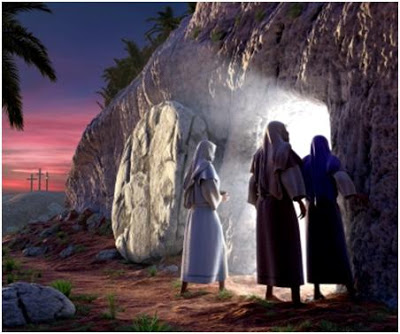
16 When the Sabbath was past, Mary Magdalene, Mary the mother of James, and Salome bought spices, so that they might go and anoint him. 2 And very early on the first day of the week, when the sun had risen, they went to the tomb. 3 And they were saying to one another, “Who will roll away the stone for us from the entrance of the tomb?” 4 And looking up, they saw that the stone had been rolled back—it was very large. 5 And entering the tomb, they saw a young man sitting on the right side, dressed in a white robe, and they were alarmed. 6 And he said to them, “Do not be alarmed. You seek Jesus of Nazareth, who was crucified. He has risen; he is not here. See the place where they laid him. 7 But go, tell his disciples and Peter that he is going before you to Galilee. There you will see him, just as he told you.” 8 And they went out and fled from the tomb, for trembling and astonishment had seized them, and they said nothing to anyone, for they were afraid.
Septuagesima 2015 What does the Bible say about our rewards?
Sermon Text
Posted in Uncategorized
Leave a comment
Transfiguration: What does the Bible say about the Son of God?
The Transfiguration of Our Lord
Matthew 17:1-9
Posted in Uncategorized
Leave a comment
Epiphany 2 What does the Bible say about our homes?
Epiphany 2
What does the Bible say about our homes?
John 2:1-11, Ephesians 5:22-33
Posted in Uncategorized
Leave a comment
Epiphany 1 What does the Bible say about the House of God?
Epiphany 1
Luke 2:41-53
![ArtBook__034_034__BoyJesusInTheTemple____[1]](https://redeemercolumbusga.org/wp-content/uploads/2015/01/artbook__034_034__boyjesusinthetemple____1.jpg)
What does the Bible say about the House of God?
We meet the Christ-child in the house of God, the Jerusalem temple, this morning. When you pray the Psalms you learn how important God’s house is to the faithful. The Psalmists write passionately about the temple saying things like, “I was glad when they said, “Let us go to the house of the Lord’ and ‘Let us enter his courts with thanksgiving.’ The temple was where one would go to commune with God for as the Psalmist said, “The Lord is in his holy temple.”
We have begun Epiphany where we remember how God is made manifest in the Christ. On Christmas we receive the gift of the Christ-child, in Epiphany we get to see what that gift is really about and what he will do. Our gospel lesson of Jesus in the temple manifests new light on that Word from Psalm 16. Indeed, “The Lord is in his holy temple.” and he is there as Israel never expected in flesh and blood, as a boy full of understanding, increasing in wisdom and in stature among his own people. St. Luke records this episode from Jesus’ boyhood because it reveals something about him. Even as a child Jesus knew whose he was, who he was, and what he had come to do. He belong to God, he is God’s Son, and he has come to be concerned of the things of his heavenly Father.
Mary and Joseph didn’t understand. Anxiously they searched for the boy for the three days and like many mothers would Mary chastised Jesus when she found him. “Why have you treated us so?” she asks. Don’t be fooled by an overly pious interpretation. Mary is accusing her son of sin. Though it was by her and Joseph’s negligence that they left the boy Jesus behind she wanted to blame him. Being sinless he had never done anything out of the ordinary before. A faithful and obedient son it is no wonder she and Joseph did not concern themselves about whether Jesus would follow them when they left for Nazareth. But, he did not. He remained among the things of God in the temple.
Jesus does not chastise his mother in return. He delicately and gently reminds her of who he is and what he is all about. “Why were you looking for me? Did you not know that I must be in my Father’s house?” Here is an implicit reminder that Joseph is not his father. It was as if he were saying “Remember mother that you are the blessed virgin and my father is not of this world.” This child who was amazing others with his understanding of the Scriptures was telling his own mother that he is also her Savior and Lord. Obedient and submissive he never once disobeyed and transgressed the commandment to honor his father and mother, but here he reminds his mother that he indeed has authority over her and all people as the Son of God. Just before Simeon had told Mary that her heart would be pierced by this child and indeed this episode would pierce her through. Her child is God and Lord and she had tried to correct him, but now she is corrected in the most loving fashion.
Jesus did indeed love his mother. That is why he is in his Father’s house conducting his Father’s business. It is for her good and the good of all people. He comes to the temple among the things of his Father; the Holy Scriptures, the teaching of the Word, the prayers of the faithful, and the sacrifices for sin. He comes to the temple on Passover to begin showing everyone that he is the true paschal lamb, the Lamb of God that taketh away the sin of the world. The twelve year old boy is there away from his mother to be her savior. Later he will be taken away from his mother again, but this time Mary’s heart will be pierced with a sword as her son is driven outside the temple to the place of the skull to bleed and to die as was foretold by the Scriptures that he now interprets to the amazement of all who hear. Jesus came to distribute the Father’s gifts of forgiveness and salvation to his mother and to his bride the church according to the Father’s will not the temper tantrums of the bride or his mother.
And what of you? Have you taken Jesus for granted? He has made your body into a temple of the Holy Spirit by forgiving you and making you his own. Have you neglected it with your sins? Have you even been so bold as to blame God for your sins, your lust, your pride, or envy? Many think they would not be envious, prideful, or lustful if only God would give them what they want. Is that any different for blaming God for our lack of composure and self control? We must be chastised too. We come into the places where we come in contact with the holy things of the Father in His Word, in His Sacraments, and we take them for granted and resist their promises. We come and receive them and can still leave embittered and unforgiving and ungrateful. Indeed, now wherever God’s Word is preached and the gifts of Christ are distributed is a House of God where the Son is about his Father’s business, but how often is that lost on us when we let our thoughts wander, when we take for granted that we are receiving the holy things of God?
Yet, as with his mother our Lord is delicate and gentle with us even in our sins. He does not increase the darkness, but brings his light to bear on our sins and to forgive them. As he opened up the Scriptures to the scribes and rabbis in the temple their hearts burned within them for they began to see that the Lord is faithful to his faithless people. Jesus would later teach again in this temple. He would ask, “Which of you convicts me of sin? And if I tell you the truth why do you not believe in me?” The greatest proof that Jesus is the Lord born to save us is not all the miraculous things he did, but in his words and in his works. He does not sin. Not against them, not against his mother, and not against you. He speaks the truth. He opens up the Scriptures. He speaks and through him come grace and truth.
Jesus honored the temple as his Father’s house, but he also taught that it had run its course. “Tear down this temple and I will rebuild it in three days.” His body is the new temple. It was torn down by human outrage that sought to chastise the sinless One. The temple of his body became the true sacrifice, the sacrifice of his flesh and blood, broken and shed for all the people. And then in three days that temple built not by human hands was raised by the Holy Spirit. Now ascended into heaven Jesus is not limited by space or time. In that human body just as before is the omnipresent, omniscient, and omnipotent God. The finite holds the infinite which is beyond all understanding. That Body sacrifice is now given wherever his Bride the church gathers to eat and drink. Those places, throughout all time whether grand cathedrals, or lowly cabins, are truly and properly called the House of God for there you still find the son about the Father’s business of saving us.
The temple of Jesus’ body is now put into your mouth in this House of God. Now you are a temple too. Consider what St. Paul says, “Do you not know that your body is the temple of the Holy Spirit who is in you, whom you have from God, and you are not your own? For you were bought at a price; therefore glorify God in your body and in your spirit, which are God’s.” How is God’s Holy Spirit put in you? By your Baptism into Christ! By the his gift faith borne of the Word of God. By the Holy Communion put into your body. This is the Father’s business. To seek and save you and to forgive you again and again, kindly, delicately, and lovingly by the forgiveness of His son. In the name of the Father, the + Son, and the Holy Spirit, amen.
 Lutheran Church of the Redeemer